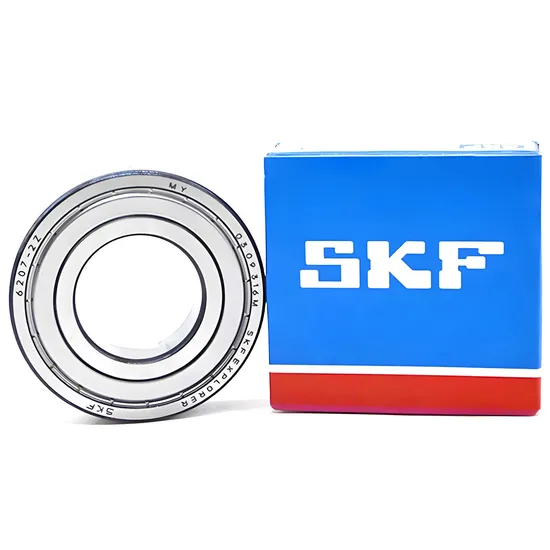
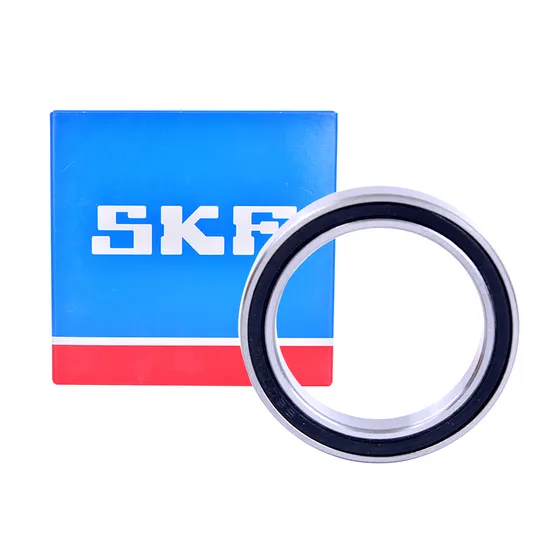
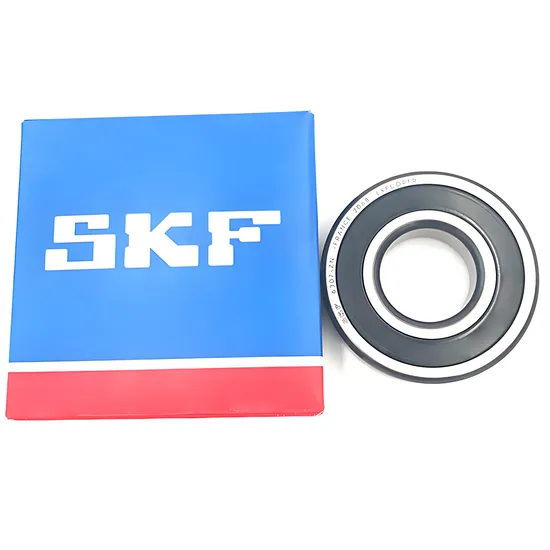
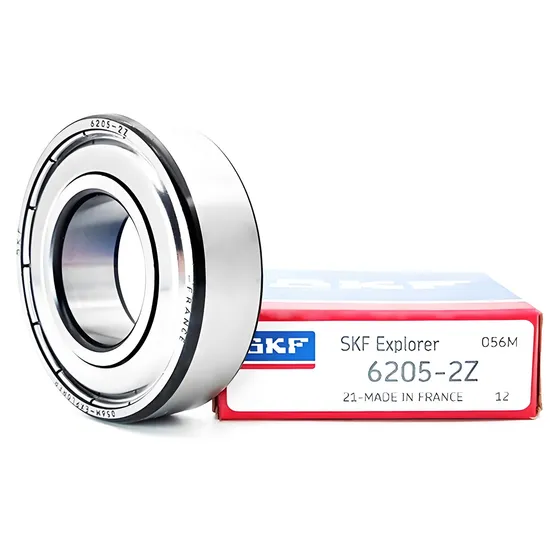
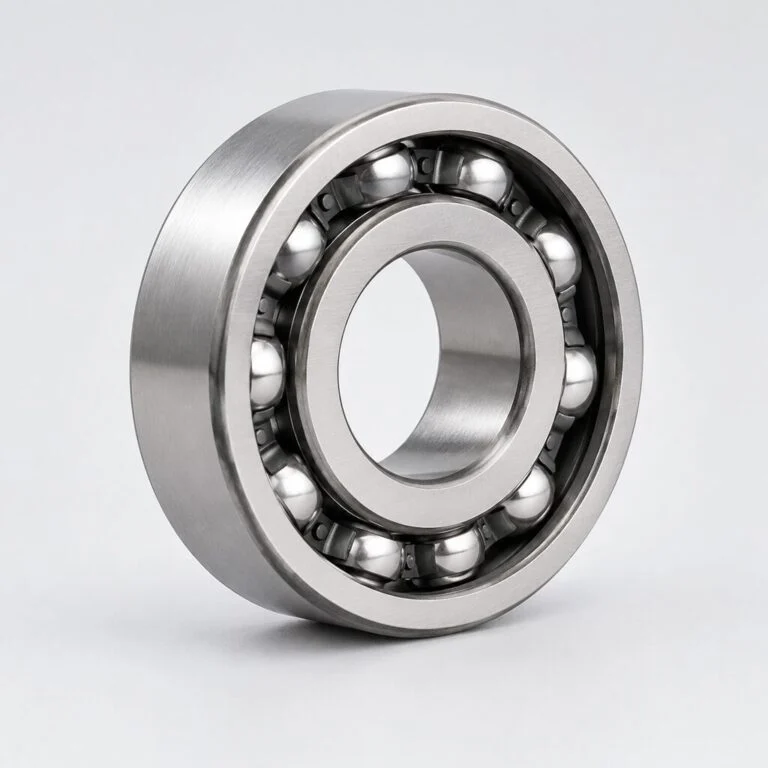
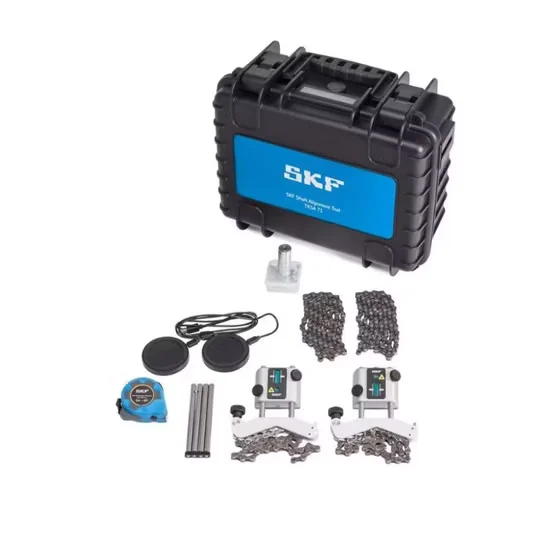
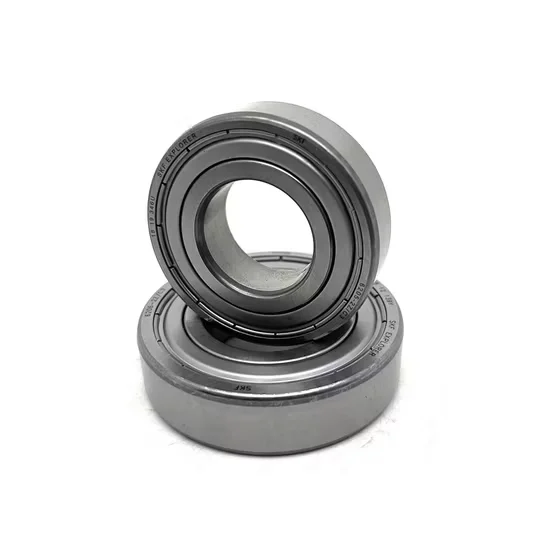
Listed data for this SKF designation; confirm the execution and dimensions against your drawing or application before ordering.
Mixed-brand consolidation — Source the SKF 6206 deep groove ball bearing alongside other OEM-specified models in a single shipment without juggling multiple vendors.
Technical Specifications
| Parameter | Value |
| Designation | SKF 6206 |
| Bearing Type | Deep Groove Ball Bearing |
| Bore Diameter (d) | 30 mm |
| Outside Diameter (D) | 62 mm |
| Width (B) | 16 mm |
| Material | Bearing Steel |
| Precision Class | P0, P6, P5, P4 |
| Lubrication | Grease or Oil |
| Origin | Sweden |
Application Suitability
| Industry | Typical Applications |
| General Industrial Machinery | Conveyor drive rollers and pump shaft supports |
| Electric Motors | Rotor shaft bearings for standard induction motors |
| Gearboxes | Intermediate shaft supports in reduction units |
Why Open Bearings Outlast Sealed Variants in Clean Gearboxes
When specifying a SKF 6206 deep groove ball bearing for enclosed gearboxes, engineers often default to sealed versions out of habit, inadvertently trapping heat and accelerating grease degradation. Early in my career at the Hanover trade fair, I watched a motor factory ruin their production line because they ignored these exact environmental mismatches.
Open designs dissipate heat far more effectively when splash lubrication is already present.
I have seen countless motor assemblies fail prematurely because a sealed bearing was forced into an oil-bath environment, causing the internal grease to wash out and the seals to overheat. Selecting the correct open or shielded configuration based on the actual housing environment prevents these silent killers.

Aligning the SKF 6206 Deep Groove Ball Bearing with Your Operating Environment
Matching this SKF 6206 deep groove ball bearing to your machinery requires looking beyond basic dimensions. We regularly help facilities transition from mismatched sealed units to open variants when the housing already provides adequate oil mist or splash lubrication. Our technical team reviews your specific radial loads and rotational speeds to confirm whether the standard bearing steel construction and your chosen precision class will maintain stability under continuous duty.
Navigating Thermal Expansion and Lubrication Integrity
In general industrial machinery, radial loads are rarely perfectly steady, and temperature fluctuations constantly test the internal clearance of the bearing. If the operating temperature rises significantly, the inner ring expands, potentially eliminating the internal clearance and causing the rolling elements to skid. In dusty environments, the lack of integrated seals means the housing must provide robust labyrinth seals or external shielding to prevent abrasive particles from entering the raceway and acting as lapping compound. Choosing between grease and oil lubrication depends entirely on whether the housing allows for continuous oil circulation or relies on periodic manual regreasing, which demands strict adherence to relubrication intervals to prevent contamination buildup.
Decoding the Baseline Specifications for Industrial Reliability
The standard 30x62x16 mm dimensions of this unit provide a balanced cross-section suitable for moderate radial and light axial loads. Because there are no specialized suffixes indicating integrated seals or non-standard clearances, this open configuration relies on the housing to manage contamination and retain lubricant. The availability of P0 through P4 precision classes allows maintenance teams to upgrade from standard commercial tolerances to high-precision variants when mounting the bearing on high-speed electric motor shafts. Upgrading to tighter tolerances ensures the inner and outer rings maintain perfect concentricity, which is absolutely critical when the bearing supports high-speed rotors where even microscopic runout causes severe vibration.
The True Cost of Ignoring Suffix and Clearance Details
Overlooking the absence of seal suffixes and installing this open bearing in a highly contaminated dust environment guarantees rapid raceway scoring and catastrophic seizure. Such misapplications lead to unplanned downtime, voided equipment warranties, and collateral damage to adjacent shafts and housings. According to failure analysis frameworks, a significant share of premature failures stems directly from applying a standard clearance bearing in an application that demands extra internal clearance to accommodate thermal expansion.
Securing Traceability and Technical Alignment for Your Fleet
Procuring genuine components means verifying the exact origin and batch traceability of every unit, especially when replacing critical motor bearings. We cross-reference your existing part numbers to ensure the precision class and lubrication state match your OEM requirements, preventing the costly mistake of installing a standard P0 bearing where a P5 is mandated. Instead of coordinating with five different suppliers for a mixed-brand maintenance overhaul, you can consolidate your entire purchase order through our platform. This approach drastically reduces administrative overhead and ensures every single unit arrives with verified documentation and rigorous dimensional checks before dispatch.
Documentation & Authenticity
- Certificate of Conformity confirming Swedish origin for the SKF 6206 deep groove ball bearing.
- Official app QR verification validating the genuine manufacturer batch number.
- Dimensional inspection reports verifying the 30x62x16 mm tolerances match the selected precision class.
- Material test certificates confirming standard bearing steel metallurgy and heat treatment.
Storage, Handling & Mounting
- Keep the original VCI packaging intact until mounting to prevent surface corrosion on the open raceways.
- Use induction heating for the 30 mm bore to ensure uniform thermal expansion without damaging the bearing steel.
- Apply clean lint-free gloves when handling the P4 precision variants to prevent skin acids from etching the raceway.
- Flush the open bearing with clean solvent if stored for extended periods before applying the specified grease or oil.
Preparing Your Technical Parameters for Selection Review
To ensure this bearing perfectly matches your application, please share your specific radial and axial load profiles, operating speeds, and housing temperature ranges. Providing your OEM equipment model numbers allows our engineering team to perform a thorough cross-reference check and verify the required precision class and internal clearance. We will then supply a detailed L10 life calculation and recommend the optimal lubrication strategy for your specific operating environment.
Frequently Asked Questions
Q: How to verify the authenticity of SKF 6206 bearings through official channels?
A: You can verify authenticity by scanning the QR code on the packaging using the manufacturer's official mobile application. We also provide a Certificate of Conformity and original factory batch traceability documents with every shipment, ensuring the bearing steel and precision class match the genuine Swedish production standards.
Q: What are the differences between P0, P6, P5, and P4 precision classes for this bearing?
A: Higher precision classes like P5 and P4 feature tighter dimensional and running accuracy tolerances, which significantly reduce vibration and noise at high rotational speeds. While P0 is sufficient for general conveyor rollers, electric motor shafts typically require P6 or higher to maintain stability and extend service life under continuous operation.
Q: How to choose between grease and oil lubrication for specific industrial applications?
A: Oil lubrication is preferred for high-speed gearboxes where splash or mist systems already exist, offering superior heat dissipation. Grease is ideal for electric motors and pumps where the housing is sealed, providing long-term lubrication without the need for complex circulation systems or frequent maintenance interventions.
Q: What are the recommended assembly tools and induction heating practices for 6206 bearings?
A: For the 30 mm bore, induction heaters are recommended to uniformly expand the inner ring without localized overheating. The heating temperature should not exceed the thermal limit of standard bearing steel, and the bearing must be mounted squarely against the shaft shoulder using appropriate fitting tools to avoid transferring force through the rolling elements.
Q: How to determine the relubrication interval for deep groove ball bearings in continuous operation?
A: The relubrication interval depends on the operating temperature, speed factor, and contamination level of the environment. We recommend monitoring the bearing temperature and acoustic emissions to establish a condition-based maintenance schedule, ensuring fresh grease is purged through the housing to expel degraded lubricant and wear particles.