
Factory-Made OEM SKF-Grade Bearings for Food Processing Supplier
Most buyers assume they must source SKF-original bearings for food lines — the real gate is whether your supplier can back up equivalent material certificates and test reports.
A food-grade bearing must simultaneously satisfy corrosion resistance, washdown durability, and food-safety compliance across material, sealing, and lubrication — and a qualified OEM alternative can match original performance at a fraction of the cost.
Back when I was stationed near Jeddah port, a full container of deep-groove ball bearings got held up because the commercial invoice listed material as "bearing steel" instead of a specific grade designation. Customs would not release the cargo until we provided mill certificates with exact alloy牌号 — and that delay cost the buyer a production-line shutdown. That incident drilled into me how food-processing buyers cannot afford documentation gaps: a missing NSF lubricant registration or an untraceable stainless-steel lot can shut down an entire audit. Over the years supplying food & beverage plants across the Middle East and Southeast Asia, I have seen the same three failure patterns repeat — and the same three compliance checkpoints get overlooked.
The pattern is clear: food-processing environments demand bearings that survive aggressive sanitation chemistry, resist moisture ingress, and leave zero contamination trail — and meeting all three simultaneously is what separates a true SKF-grade bearing from a generic stainless unit.
What Makes a Bearing "Food-Grade"?
A food-grade bearing is not defined by stainless material alone — it requires synchronized compliance across material grade, seal design, and lubricant registration.
Many procurement teams default to specifying "stainless steel bearing" and assume the job is done. In reality, food-safety auditors look at three separate layers, and failure at any one layer disqualifies the unit.
The first layer is material corrosion resistance. Austenitic grades such as AISI 440C offer moderate corrosion resistance with good hardness, while AISI 304 provides broader chemical resistance at lower load capacity, and AISI 316L delivers the highest chloride resistance for environments involving salty or acidic food products. Selecting the wrong grade means pitting corrosion starts within months — not years.
The second layer is seal integrity. Contact seals (typically NBR or FKM lip seals) block water and cleaning-agent ingress far more effectively than non-contact shields, but they also generate additional friction and heat. In high-speed conveyor applications, the trade-off must be evaluated case by case.
The third layer is lubricant compliance. Any grease used in food-zone bearings must carry NSF H1 registration, confirming incidental-contact safety under FDA 21 CFR framework. A bearing with perfect seals but unregistered grease will still fail a HACCP audit.
| Compliance Layer | Basic Stainless Unit | Full Food-Grade Unit |
|---|---|---|
| Material Certification | Self-reported | Mill-tested, traceable lot |
| Seal Type | Non-contact shield | Contact lip seal, FDA-compliant elastomer |
| Lubricant | Industrial grease, no registration | NSF H1 registered, food-safe |
| Documentation | Invoice only | Material cert + NSF certificate + ISO file |
A dairy processing plant in Southeast Asia once switched from a basic stainless unit to a fully documented food-grade configuration — and their bearing replacement interval extended from single-digit months to well over two years of continuous washdown operation.
SKF-Grade vs OEM Alternative: Performance Comparison
A properly manufactured OEM bearing can match SKF-grade performance in food-processing duty — the differentiator is documentation discipline, not brand stamp.
The assumption that only SKF-original bearings are acceptable in food lines is one of the most persistent myths I encounter. What food-safety regulators actually require is verifiable material traceability and lubricant compliance — not a specific logo on the seal.
When I compare OEM-produced units against SKF-reference specifications for food-grade deep-groove ball bearings, the dimensional tolerances, material chemistry, and seal performance overlap substantially — provided the OEM factory maintains ISO 9001 certification and can produce batch-level material certificates on request.
| Comparison Factor | SKF Original | Certified OEM Equivalent |
|---|---|---|
| Dimensional Tolerance | P6/P5 standard | P6 achievable per ISO 492 |
| Material Traceability | Full mill certificate | Batch-level certificate available |
| Seal Performance | Proven lip seal design | Equivalent contact seal, FDA elastomer |
| Lubricant | NSF H1 registered | NSF H1 registered, same base oil |
| Cost Position | Premium pricing | Substantially lower, volume-discounted |
| Lead Time | Standard global schedule | Stock dispatch, express delivery available |
The cost gap is significant: OEM equivalents typically run at a fraction of branded pricing, with no sacrifice in food-zone reliability — as long as the supplier can produce the paperwork. A meat processing facility in the Gulf region switched their conveyor-line bearings from branded to OEM-equivalent units and passed their annual HACCP re-audit without a single nonconformance related to bearing lubrication or seal integrity.
What matters is not the brand name — it is whether the supplier can hand you a complete documentation package before the bearing ever reaches your machine.
Common Failure Modes in Food Processing
Washdown corrosion, seal degradation, and lubricant contamination account for the overwhelming majority of food-line bearing failures — and all three are preventable with correct specification.
Walking through a beverage bottling plant or a ready-meal production facility, you see the same destruction patterns over and over. High-pressure hot water and caustic cleaning agents attack bearing surfaces, seals lose their lip integrity, and degraded grease migrates into the product zone.
The first failure mode is washdown-induced corrosion. Even stainless bearings will corrode if the wrong grade is specified for the chemical environment. Chloride-based cleaning agents attack AISI 440C noticeably faster than AISI 316L, and pitting often starts at the seal groove — a location that is invisible during routine visual inspection.
The second failure mode is seal lip degradation. Continuous exposure to hot caustic solutions causes elastomer hardening and cracking. Once the seal lip loses contact pressure, water and cleaning chemicals penetrate the bearing cavity, washing out the grease and initiating internal corrosion. Non-contact shields offer virtually no protection in these conditions.
The third failure mode is lubricant migration. When non-food-grade grease is used — or when food-grade grease degrades under thermal stress — breakdown products can migrate along the shaft into the product zone. This is the failure mode that triggers the most serious food-safety incidents and recall risks.
| Failure Mode | Root Cause | Preventive Action |
|---|---|---|
| Washdown corrosion | Wrong material grade for chemical environment | Upgrade to 316L for chloride exposure |
| Seal degradation | Elastomer incompatibility with caustic cleaners | Specify FKM lip seal, verify chemical resistance |
| Lubricant migration | Non-H1 grease or thermal breakdown | Use NSF H1 registered grease, monitor temperature |
A poultry processing plant in South America experienced repeated bearing seizures on their evisceration line conveyor. Root-cause analysis revealed that the original bearings used non-contact shields with industrial grease — neither seal nor lubricant was food-zone rated. After switching to contact-sealed, NSF H1-lubricated units, the line ran for an extended period without a single unplanned bearing stoppage.
How to Verify Supplier Compliance
Before placing a food-grade bearing order, demand three documents: material mill certificate, NSF H1 lubricant registration proof, and ISO 9001 quality system certificate — anything less is unacceptable.
Verification is where many buyers get caught. A supplier may claim "food-grade" on a product page, but when you ask for supporting documents, the response is vague or delayed. In food-processing procurement, vague means risky.
The first document to request is the material mill certificate. This should specify the exact stainless-steel grade (e.g., AISI 440C, AISI 316L), the heat number, and the chemical composition breakdown. A certificate that only says "stainless steel" without a grade designation is functionally useless for audit purposes.
The second document is the NSF H1 lubricant registration certificate. The certificate should clearly show the grease brand and product code, the registration scope (H1 — incidental food contact), and the current validity period. Expired registrations are as bad as no registration.
The third document is the supplier’s ISO 9001 quality management system certificate. This confirms that the manufacturing facility operates under a documented quality system with traceable production records. For buyers in regions requiring SABER or similar conformity assessment, the ISO certificate is the foundation document that enables downstream certification.
| Document | What to Check | Red Flag |
|---|---|---|
| Material Certificate | Grade designation, heat number, chemistry | Generic "stainless steel" label |
| NSF H1 Certificate | Product code, H1 scope, validity date | Expired or scope mismatch |
| ISO 9001 Certificate | Issuing body accreditation, scope coverage | Unaccredited issuer, expired |
I once worked with a Middle East food factory whose import shipment was held at customs because the bearing material certificates did not match the invoice grade designation. The supplier had shipped 304-grade units but invoiced them as 440C. Resolving that mismatch required re-issuing documents, re-labeling cartons, and paying storage fees — a delay that stretched across multiple weeks.
Since that experience, I verify every document line-by-line before any food-grade shipment leaves the warehouse. The cost of that discipline is minutes; the cost of skipping it can be a production-line shutdown.
Application-Specific Selection Guide
Different food-processing zones demand different bearing configurations — filling lines, conveyors, and packaging stations each have distinct corrosion, load, and speed profiles.
A common mistake is specifying the same bearing type across an entire food plant. In reality, a bearing on a high-pressure filling-line filler faces a fundamentally different environment than a bearing on a dry-packaging conveyor — and the specification should reflect that.
For filling and mixing zones, where bearings are directly exposed to product splash and frequent high-pressure washdown, the priority is maximum corrosion resistance and seal integrity. AISI 316L material with FKM contact seals and NSF H1 grease is the baseline configuration. These bearings must resist chloride attack from cleaning agents and prevent any grease migration into the product.
For conveyor and transport zones, where bearings carry moderate loads at lower speeds and face intermittent washdown, AISI 440C or AISI 304 with NBR or FKM contact seals is typically sufficient. The key requirement is seal durability under repeated wet-dry cycling, not extreme corrosion resistance.
For packaging and palletizing zones, where bearings operate in relatively dry conditions with minimal washdown exposure, standard chrome-steel bearings with appropriate sealing may be acceptable — provided they are located outside the food splash zone and do not pose a contamination risk.
| Processing Zone | Recommended Material | Seal Type | Lubricant |
|---|---|---|---|
| Filling / Mixing | AISI 316L | FKM contact lip | NSF H1 registered |
| Conveyor / Transport | AISI 440C or 304 | NBR/FKM contact lip | NSF H1 registered |
| Dry Packaging | Chrome steel (if outside splash zone) | Rubber seal or shield | Standard or H1 per risk assessment |
A beverage bottling operation in Central Asia redesigned their bearing specification by zone — upgrading filling-zone bearings to 316L with FKM seals while retaining 440C units on dry conveyors. The result was a noticeable reduction in unplanned downtime on the filling line, without over-specifying (and over-paying for) bearings in lower-risk zones.
The principle is simple: match the bearing to the zone’s actual exposure profile. Over-specifying wastes budget; under-specifying invites failure.
Conclusion
Food-grade bearing reliability is a documentation problem as much as a metallurgy problem — and a disciplined OEM supplier with full traceability can deliver SKF-grade performance without the brand premium.
Material grade, seal design, and lubricant registration must all align for a bearing to survive food-processing duty — and the supplier who cannot produce mill certificates, NSF H1 proof, and ISO 9001 documentation on request is not a food-grade supplier, regardless of what their catalog claims.
Products in this article
SKF bearings mentioned above
 01 Clutch Release Bearings LM501349/LM501310 501349/10 Double Row Roller Bearing OEM View model details
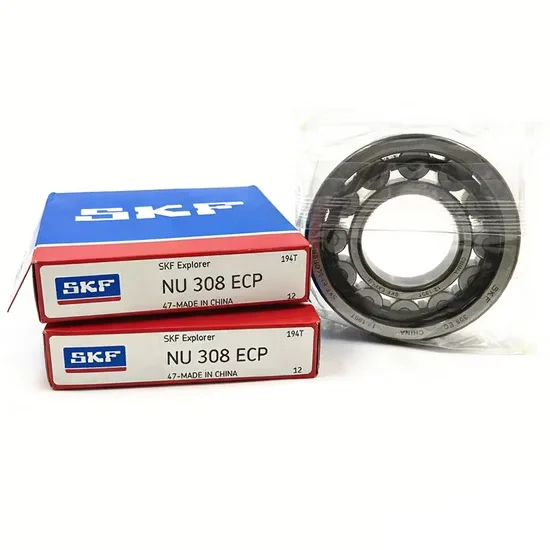 02 Cylindrical Roller Bearings SKF NU308ECP Cylindrical Roller Bearing for Gearbox Reducer OEM View model details
 03 Deep Groove Ball Bearings Genuine SKF Deep Groove Ball Bearings 6201-6206 OEM ODM Supply View model details
 04 Tapered Roller Bearing SKF 32218 Conical Roller Bearing 90x160x42.5mm for Wind Power & Automotive OEM Applications View model details
Applications
Where these SKF bearings are used
Keep reading
Related SKF bearing selection guides
More practical notes on SKF designations, precision items and project bearing lists from Project Purchasing Company.
 Applications & Industries · · 7 min read Ball Bearings for Model Engines: Wholesale Supplier & Bulk Orders Standard industrial bearings fail in model engines due to incorrect clearances and cage materials. Ball Bearings in Model Engines require specific tight tolerances, machined… Read the guide Applications & Industries · · 7 min read Ball Bearings for Garden Tillers: Genuine Wholesale Supplier Genuine Ball Bearings in Garden Tillers prevent costly field failures caused by mud ingress and shock loads. Discover critical selection criteria for sealing and… Read the guide Applications & Industries · · 7 min read Ball Bearings for Pressure Washers Wholesale Supplier Stop premature pump failures by prioritizing seal integrity over basic dimensions for Ball Bearings in Pressure Washers. Learn why high-temperature contact seals and synthetic… Read the guide

Request a quote
Send your SKF list. Get one itemized written quote.
Project Purchasing Company supplies SKF ball, roller, precision and housed bearing units to distributors, repair workshops and project buyers worldwide. Standard and precision items are priced line by line, with accessories kept on the same quote.