
Custom OEM Bearings for Printing Press OE Manufacturers
Matching the part number is never enough—tolerance band and internal clearance alignment decide whether a bearing survives the first week or the first decade.
Sourcing custom OEM bearings for printing press OE manufacturers requires verified cross-reference compatibility, ISO-certified documentation, and application-based selection that accounts for high-speed continuous operation, not just dimensional matching.
I still remember standing on the floor of a European printing plant a few years back, watching a line sit idle because a replacement bearing had been installed that "matched the OEM drawing perfectly." The outer diameter was right, the bore was right, the width was right. But the internal clearance group was wrong for the thermal expansion profile of that specific spindle, and the bearing seized within hours. The press was down for an extended period, and the cost of that downtime dwarfed the price difference between the bearing they bought and the one they should have bought. That incident reshaped how I think about custom OEM bearings for printing press OE manufacturers—and how I advise buyers to approach the entire procurement process.
The reality is that printing presses operate under conditions that most general-purpose industrial equipment never encounters. Continuous high-speed rotation, tight registration tolerances, thermal cycling, and vibration sensitivity mean that bearing performance directly translates into print quality and production uptime. Getting this wrong is expensive. Getting it right requires a supplier who understands both the bearing and the machine it will live in.
Why Printing Presses Demand Precision Bearings Beyond Standard Specs?
Standard catalog bearings often fail to meet the thermal, speed, and vibration requirements of modern printing press splices and impression cylinders.
Printing presses—whether offset, flexographic, or gravure—run at speeds that push bearings into a regime where standard P0 tolerance grades simply do not hold up. The impression cylinder bearings, for example, must maintain positional accuracy within microns over thousands of revolutions per hour, across shifts that run continuously. Any drift in the bearing’s running accuracy translates directly into misregistration on the printed sheet.
I have seen buyers order what they believed to be identical replacements from multiple sources. The dimensional specs matched on paper. But when the bearings were installed, vibration levels spiked, and the print quality degraded noticeably. The root cause was not the bearing size—it was the running accuracy and the internal clearance behavior under operating temperature. A bearing that performs perfectly at room temperature during bench testing may behave entirely differently once the spindle reaches thermal equilibrium at operating speed.
This is where the selection of custom OEM bearings for printing press OE manufacturers diverges sharply from generic industrial procurement. You need a supplier who can verify not just the part number, but the tolerance band, the clearance class, the cage design, and the lubrication compatibility for your specific operating conditions. The bearing is not a commodity here—it is a precision component that directly governs your press’s ability to hold registration.
How to Verify Cross-Reference Compatibility Before Ordering?
A complete cross-reference verification must go beyond dimensional matching to include clearance class, precision grade, cage type, and lubrication specification alignment.
One of the most common mistakes I see in the field is treating an OEM cross-reference number as a complete specification. It is not. The OEM number tells you the envelope dimensions and the basic load ratings. It does not always tell you the clearance class the original equipment manufacturer selected for that specific application, nor does it always specify the cage material or the precision grade required for the operating speed.
When a buyer sends me an OEM number for a printing press bearing, the first step is to pull the original equipment manufacturer’s technical documentation for that specific machine model and position. Then we map the bearing against our catalog—not just by bore, OD, and width, but by every parameter that affects performance in that application.
Here is what a proper verification looks like in practice:
- Confirm the dimensional envelope matches the OEM specification.
- Identify the required precision grade for the application position—spindle bearings typically require higher grades than support bearings.
- Verify the internal clearance class against the expected thermal expansion and load profile.
- Confirm cage material compatibility with the lubrication system and operating temperature.
- Check seal or shield type if the application demands contamination protection.
- Validate the lubrication fill type and quantity against the OEM specification.
A distributor in the Middle East once placed an order for a full set of printing press replacement bearings based solely on dimensional cross-reference. When the bearings arrived and were installed, two positions on the press experienced premature heating. The bearings were dimensionally correct, but the clearance class was too tight for the thermal profile of those specific cylinder positions. The entire set had to be pulled, re-specified, and resupplied. The cost of the bearing was negligible compared to the labor and downtime involved.
What Documentation Should You Request from Bearing Suppliers?
ISO 9001 certification, material traceability reports, and dimension inspection certificates form the minimum documentation threshold for any printing press bearing procurement.
I have walked through warehouses where buyers stored bearings without any documentation at all. When a failure occurred, there was no way to trace the material batch, no way to verify the heat treatment, and no way to confirm that the bearing was manufactured to the claimed specification. In a printing press environment—where a single bearing failure can halt an entire production line—this is unacceptable risk management.
When sourcing custom OEM bearings for printing press OE manufacturers, the documentation package is as important as the product itself. Here is what you should expect from any credible supplier:
- ISO 9001 certification: This confirms that the manufacturer operates under a recognized quality management system. It does not guarantee that every bearing is perfect, but it confirms that processes are controlled and auditable.
- Material certification: Traceability to the steel batch, including chemical composition and inclusion ratings. This is critical for verifying fatigue life expectations.
- Dimensional inspection report: Batch-level or piece-level measurement data confirming that the bearing meets the claimed tolerance grade.
- Hardness test report: Confirmation that the raceways and rolling elements meet the required hardness specification after heat treatment.
- Lubrication specification sheet: Details of the grease or oil fill, including base oil viscosity, thickener type, and operating temperature range.
A European printing company I worked with learned this lesson the hard way. They had been purchasing replacement bearings from a local distributor for years without requesting documentation. When a bearing failed and caused a web break that damaged the blanket cylinder, they tried to trace the failure back to the manufacturer. The local distributor could not provide any material or inspection documentation. The bearing was eventually identified as a non-conforming product from an unverified source. The lesson was clear: documentation is not paperwork—it is your evidence that the bearing was built to do the job.
How to Balance Cost and Reliability for Printing Press Maintenance?
Verifiable alternative bearings with complete technical documentation often deliver better long-term value than blindly specifying original equipment manufacturer parts.
There is a persistent belief in the printing industry that only the original equipment manufacturer’s branded bearing will perform correctly. This is not always true—and in many cases, it is not even cost-effective. What matters is not the brand on the box, but the bearing’s ability to meet the application’s technical requirements consistently, batch after batch.
I have supplied custom OEM bearings for printing press OE manufacturers to operations across multiple regions, and the pattern is consistent: the buyers who perform best over time are those who focus on specification verification rather than brand loyalty. They understand that a bearing from a certified manufacturer, matched to the application through proper cross-reference analysis, will perform identically to the original—often at a lower cost and with shorter lead times.
Consider a packaging printing operation in South America that was facing extended lead times and premium pricing for original equipment manufacturer branded bearings. Every time a press needed a bearing replacement, they faced production delays of several weeks. They switched to a verified alternative supplier who could provide the same specification bearings with full documentation and significantly faster delivery. The result was not just cost savings—it was a meaningful reduction in unplanned downtime because replacement bearings were available when needed, not weeks later.
The key is verification. You need confidence that the alternative bearing meets every technical requirement of the original. This means demanding the same documentation package you would expect from the original equipment manufacturer. It means confirming precision grade, clearance class, cage type, and lubrication compatibility. When these are verified, the alternative bearing is not a compromise—it is a strategic choice.
Conclusion
Printing press bearing procurement is a technical discipline, not a commodity purchase.
The difference between a bearing that holds registration for years and one that fails within months lies in specification accuracy, cross-reference verification, and documentation integrity. Buyers who invest the time to validate these factors—rather than relying solely on part numbers or brand names—consistently achieve better uptime, lower total cost, and more predictable maintenance cycles. The right supplier for custom OEM bearings for printing press OE manufacturers is one who treats every order as a technical engagement, not a catalog transaction.
Products in this article
SKF bearings mentioned above
 01 Clutch Release Bearings LM501349/LM501310 501349/10 Double Row Roller Bearing OEM View model details
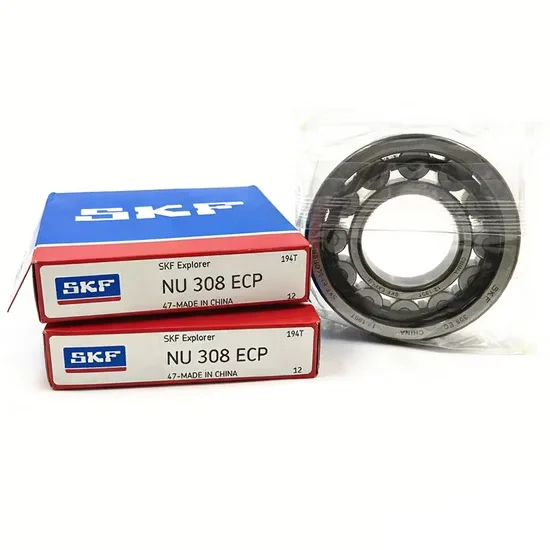 02 Cylindrical Roller Bearings SKF NU308ECP Cylindrical Roller Bearing for Gearbox Reducer OEM View model details
 03 Deep Groove Ball Bearings Genuine SKF Deep Groove Ball Bearings 6201-6206 OEM ODM Supply View model details
 04 Tapered Roller Bearing <p> 32218 Rodamiento de rodillos cónicos 90x160x42.5mm para aplicaciones OEM de energía eólica y automotriz View model details
Applications
Where these SKF bearings are used
Keep reading
Related SKF bearing selection guides
More practical notes on SKF designations, precision items and project bearing lists from Project Purchasing Company.
 Applications & Industries · · 7 min read Ball Bearings for Model Engines: Wholesale Supplier & Bulk Orders Standard industrial bearings fail in model engines due to incorrect clearances and cage materials. Ball Bearings in Model Engines require specific tight tolerances, machined… Read the guide Applications & Industries · · 7 min read Ball Bearings for Garden Tillers: Genuine Wholesale Supplier Genuine Ball Bearings in Garden Tillers prevent costly field failures caused by mud ingress and shock loads. Discover critical selection criteria for sealing and… Read the guide Applications & Industries · · 7 min read Ball Bearings for Pressure Washers Wholesale Supplier Stop premature pump failures by prioritizing seal integrity over basic dimensions for Ball Bearings in Pressure Washers. Learn why high-temperature contact seals and synthetic… Read the guide

Request a quote
Send your SKF list. Get one itemized written quote.
Project Purchasing Company supplies SKF ball, roller, precision and housed bearing units to distributors, repair workshops and project buyers worldwide. Standard and precision items are priced line by line, with accessories kept on the same quote.