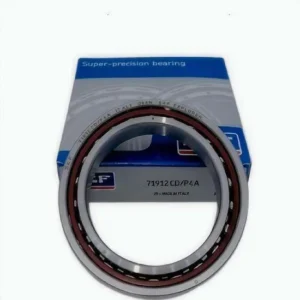
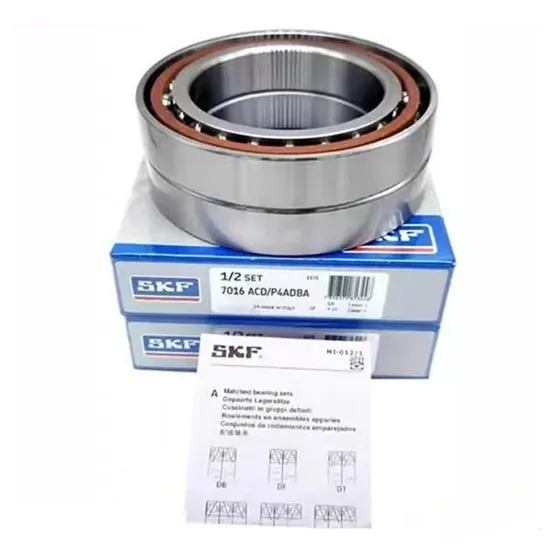
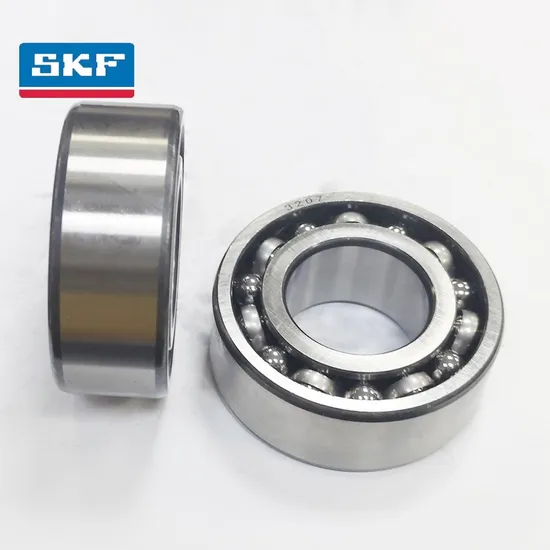
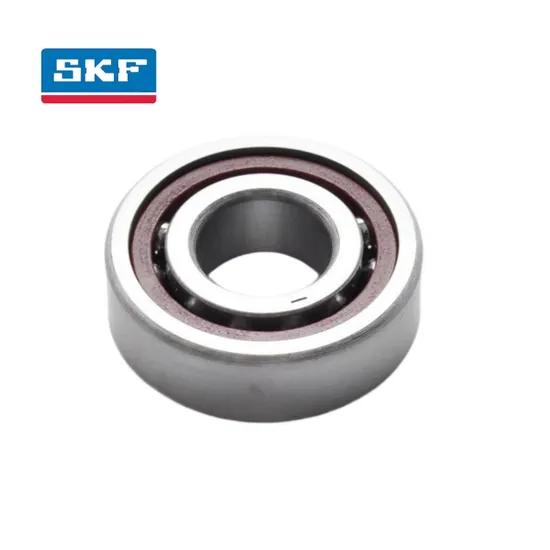
Listed data for this SKF designation; confirm the execution and dimensions against your drawing or application before ordering.
Authorized Channel Procurement — Every SKF 7014 FE/HCP4ALQBCA unit we supply ships with traceable batch documentation from verified distributor networks, ensuring the P4A running accuracy you expect reaches your spindle assembly intact.
Technical Specifications
Parámetro
Value |
| Designation | SKF 7014 FE/HCP4ALQBCA |
Tipo de Rodamiento
Angular Contact Ball Bearing |
Diámetro del agujero (d)
70 mm
Diámetro exterior (D)
110 mm
Número de Filas
Fila Única
Ángulo de contacto
15° |
Clase de precisión
P4A (ISO tolerance class 4 with additional running accuracy) |
Material de la jaula
Phenolic resin (fabric-reinforced) |
Origen
China
Peso
0.100 kg
Suffixes FE, /HC, and LQBCA require confirmation against the manufacturer catalog for complete application-specific decoding.
Application Suitability
Industria
Aplicaciones Típicas
| Machine tool manufacturing | CNC lathe main spindle, machining center spindle cartridge |
| Precision equipment | Coordinate measuring machine rotary table, optical grinding head |
| Robotics | High-speed harmonic drive input shaft, articulated joint actuator |
What Happens When a 15° Contact Angle Meets a 40° Load Profile
Mismatched contact angles silently destroy spindle bearings long before vibration alarms trigger.
Procurement engineers often match the base designation — 7014, 70 mm bore, 110 mm OD — and assume interchangeability. But when a spindle designed around a 15° contact angle receives a 25° or 40° substitute, the axial stiffness drops, thermal growth goes uncompensated, and the inner ring creeps on the shaft seat. We have seen rejected batches where the only difference was a suffix the supplier overlooked.

Matching the SKF 7014 FE/HCP4ALQBCA to Spindle Duty Cycles
The SKF 7014 FE/HCP4ALQBCA sits in a demanding niche: high-speed rotation with tight runout requirements and predominantly radial loading. Its 15° contact angle keeps friction heat low at sustained rpm, while the single-row angular contact geometry handles the combined radial-axial envelope typical of belt-driven or direct-drive spindle cartridges. When a buyer sends us an OEM equipment number, we cross-verify not just the bore and OD but the cage material, precision class, and contact angle together — because a phenolic cage at P4A tells a very different application story than a polyamide cage at P5.
Thermal Growth, Lubrication Envelope, and the P4A Requirement
Spindle bearings operate in a narrow thermal window. Grease degradation accelerates once the outer ring exceeds its design ceiling, and the phenolic resin cage on this model depends on consistent oil-film thickness to survive high-speed shear. A 15° contact angle generates less internal heat than steeper variants, but it also means axial preload must be precisely set during mounting — too light and the balls skid, too heavy and the cage overheats. Installation practices such as controlled induction heating of the housing and clean-room assembly directly determine whether the P4A running accuracy survives the first week of production.
Decoding the Specifications That Matter
The P4A designation references ISO 492 class 4 dimensional tolerances with an added running accuracy constraint — bore and OD sit within standard P4 bands, but radial and axial runout are held tighter. For a 70 mm bore, this means the inner ring bore tolerance and the assembled radial runout both meet demanding limits that standard P5 or P4 grades do not guarantee. The phenolic resin cage, lightweight and fabric-reinforced, is chosen for high-speed spindle service because it dampens ball-cage contact forces and resists deformation under centrifugal loading far better than pressed steel or unreinforced polyamide. The 15° contact angle strikes a balance: enough axial capacity to manage thrust from tool-change mechanisms or belt tension, yet low enough to avoid the friction penalties that 25° or 40° angles impose at sustained high rpm. Single-row construction means this bearing must be mounted in a defined arrangement — typically back-to-back or face-to-face with a matched counterpart — to manage bidirectional axial loads.
The Hidden Cost of a Suffix Oversight
A CNC shop replaces a failed spindle bearing with a unit that matches the base number but carries a different precision suffix. The new bearing reaches P5 instead of P4A. Within weeks, chatter marks appear on workpiece surfaces, vibration readings climb, and the spindle must be pulled for rework. ISO 15243 classifies such outcomes under geometric fatigue and smearing — failure modes that trace back to selection errors rather than manufacturing defects. The unplanned downtime, scrap parts, and labor hours dwarf the price difference between the correct and incorrect suffix.
How We Reduce Procurement Risk on Precision Bearings
Every SKF 7014 FE/HCP4ALQBCA we quote originates from authorized distributor channels with batch-level traceability. Our cross-reference database checks clearance, cage material, and precision suffix together — not just the base designation — so substitution errors are caught before the purchase order is issued. We provide QR-code verification pathways through the manufacturer's official app, and our documentation package includes country-of-origin paperwork formatted for import compliance. When an application involves unusual speed or temperature conditions, our technical team reviews the load spectrum and recommends the correct preload arrangement rather than shipping a catalog part and hoping it fits.
Documentation & Authenticity
- Supplier Certificate of Conformity referencing the specific batch and lot number of the SKF 7014 FE/HCP4ALQBCA shipment
- Third-party runout inspection confirming P4A running accuracy before dispatch
- QR-code scan pathway enabling verification through the SKF official authentication app
- Country-of-origin certificate prepared for customs clearance and import documentation requirements
- Material and dimensional inspection reports available on request per shipment batch
Storage, Handling & Mounting
- Keep the SKF 7014 FE/HCP4ALQBCA in its original sealed packaging until the moment of spindle assembly; premature exposure risks moisture contamination of the phenolic cage
- Store flat in a temperature-stable environment away from direct sunlight to prevent cage resin degradation before installation
- Use lint-free gloves during handling — fingerprints on P4A-grade raceway surfaces introduce corrosion initiation points that compromise running accuracy
- Mount the inner ring using controlled induction heating; cold-press fitting on a 70 mm bore risks brinelling the ball-raceway contact and voiding the precision class
- Verify shaft and housing seat tolerances against the P4A bore and OD bands before assembly; interference fits outside the specified range distort the ring geometry and destroy runout accuracy
Request a Technical Review Before You Commit
Share your spindle speed, preload requirement, and OEM equipment number so we can verify the SKF 7014 FE/HCP4ALQBCA is the correct configuration — including the unverified suffixes — for your exact application. We will return a cross-reference confirmation, lead time estimate, and documentation package outline within one business day.
Preguntas Frecuentes
Q: How can I verify the authenticity of an SKF bearing before installation?
A: Scan the QR code on the packaging using the SKF official app. The app cross-references the batch number against the manufacturer's production records. We also supply a Certificate of Conformity with each shipment for independent verification.
Q: Why must the precision suffix match exactly — isn't P4 close enough to P4A?
A: P4 and P4A both reference ISO 492 class 4 dimensional tolerances, but P4A adds a stricter running accuracy specification. In spindle applications, that additional runout control is often the difference between acceptable surface finish and chatter marks on the workpiece.
Q: What does the 15° contact angle mean for my spindle design?
A: A 15° contact angle provides moderate axial capacity while minimizing friction heat generation at high speed. It is the standard choice for spindles where radial loads dominate and sustained high rpm is required.
Q: How do I confirm what the FE, /HC, and LQBCA suffixes mean for my application?
A: These suffixes carry application-specific meanings that require confirmation against the manufacturer's current catalog. When you send us your OEM equipment number or application parameters, we verify the complete suffix string before quoting.
Q: Can I substitute a polyamide cage bearing in place of this phenolic resin cage?
A: Phenolic resin cages are specified for high-speed spindle service because they handle centrifugal forces and maintain dimensional stability under thermal stress better than polyamide. Substituting cage material without engineering review risks premature cage failure at sustained high rpm.
Confirm Your Spindle Bearing Configuration Today
Send us your OEM equipment number or application parameters — speed, load, temperature, and preload — and we will verify the complete suffix match and return a sourcing proposal with full documentation.