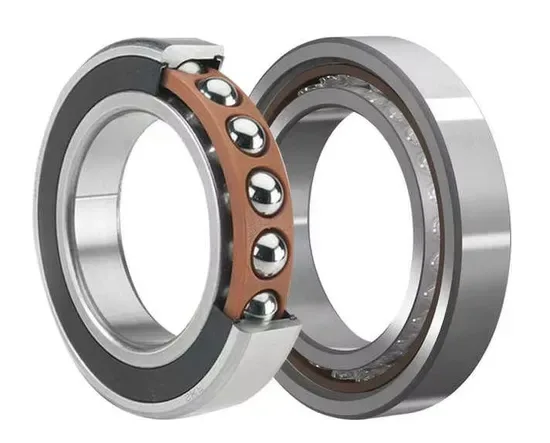
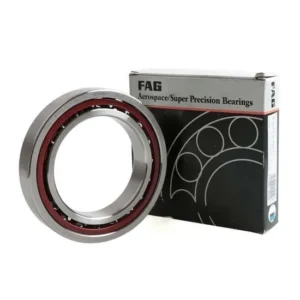
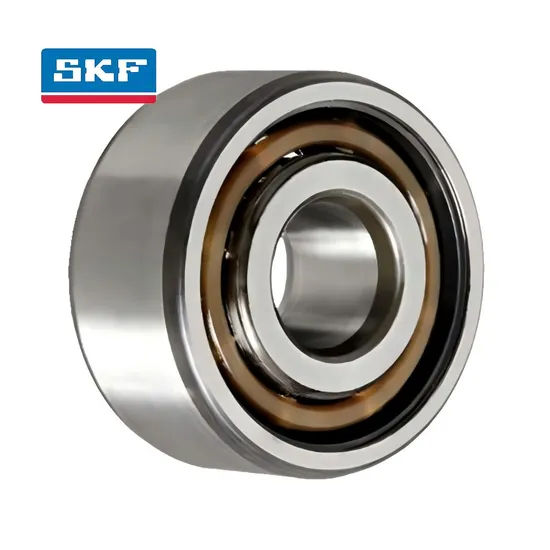
Listed data for this SKF designation; confirm the execution and dimensions against your drawing or application before ordering.
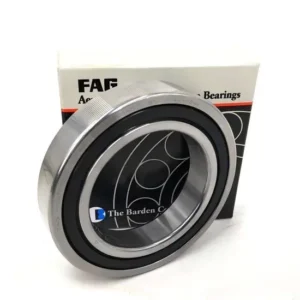
Authorized Channel Procurement — Every FAG HC7004-C-T-P4S angular contact ball bearing we ship traces back to documented distributor allocations with verifiable lot numbers for customs and compliance audits.
Technical Specifications
| Parameter | Value |
| Designation | FAG HC7004-C-T-P4S |
| Bearing Type | Single Row Angular Contact Ball Bearing |
| Bore Diameter (d) | 20 mm |
| Outside Diameter (D) | 42 mm |
| Width (B) | 12 mm |
| Contact Angle | 15° |
| Cage Material | Phenolic Resin (Fabric-reinforced) |
| Seal or Shield Type | Open |
| Precision Class | P4S |
| Arrangement | Single |
| Number of Rows | Single Row |
| Weight | 0.080 kg |
| Origin | China |
Note: Suffixes HC, T, and P4S in the FAG HC7004-C-T-P4S angular contact ball bearing designation fall outside the standard FAG spindle bearing catalog and require confirmation against the manufacturer's current technical documentation before final procurement.
Application Suitability
| Industry | Typical Applications |
| Industrial Machinery | CNC lathe main spindle front support |
| Precision Equipment | High-speed grinding wheel head bearing |
| Electric Motors | High-frequency motor shaft support |
| General MRO | Robotics joint actuator bearing replacement |
What Happens When a Spindle Bearing Suffix Gets Ignored
A 15° contact angle bearing forced into a 25° application will over-axial-load within the first thermal cycle.
I watched a batch of 7004 angular contacts fail inside seven days at a spindle builder in Ningbo. The procurement engineer matched the bore and outside diameter perfectly but treated the suffix as optional. The standard steel ball variant we shipped could not survive the rotational speed envelope the application demanded. The cage cracked under centrifugal stress, and the spindle seized mid-cut. That single oversight cost the buyer a repeat customer and taught our team that in high-speed angular contact bearings, the suffix string is not decoration — it is the entire engineering specification. The FAG HC7004-C-T-P4S angular contact ball bearing carries a suffix combination that demands the same level of scrutiny before installation.

Matching the HC7004-C-T-P4S to High-Speed Spindle Envelopes
Spindle applications impose simultaneous radial cutting loads and axial thrust from tool clamping mechanisms. The 15° contact angle in this bearing generates lower friction torque at speed compared to 25° variants, which matters when the spindle runs continuously above typical machining thresholds. We cross-reference the application envelope — speed, load direction, thermal gradient — against the bearing's suffix chain before confirming suitability. Buyers who substitute based on bore and OD alone often discover the mismatch only after thermal growth closes the internal clearance to zero. Our engineering review catches those substitutions at the inquiry stage, not on the shop floor.
Thermal Growth, Load Direction, and the Precision Envelope
High-speed spindles create steep temperature gradients between the inner ring, which rotates with the shaft, and the outer ring, seated in a housing that dissipates heat unevenly. A 15° contact angle reduces axial preload sensitivity under thermal expansion, but it also means the bearing carries less axial capacity in a single direction than a 25° or 40° variant. Lubrication choice compounds this: oil-air systems keep cage temperatures stable, while grease-packed arrangements risk thermal runaway if re-lubrication intervals are missed. Installation fit on a 20 mm bore requires controlled induction heating — pressing cold risks brinelling the raceway before the spindle ever starts.
Decoding the Suffix Chain: C, T, and the P4S Question
The C suffix confirms a 15° contact angle, positioning this bearing for predominantly radial loads with moderate axial components. The T suffix typically references a phenolic resin fabric-reinforced cage in FAG spindle nomenclature, a material chosen for its low mass and stable behavior at elevated rotational speeds — it dampens ball-to-cage vibration better than brass alternatives in the smaller bearing sizes. The P4S designation extends beyond standard P4 ISO tolerance class, though its exact meaning within FAG's current catalog requires catalog verification. What is clear: the base P4 tolerance already demands tighter dimensional and running accuracy than P5, reducing assembled runout on the spindle nose to levels that preserve surface finish on machined parts.
The Invoice Price vs. the Real Cost of a Wrong Suffix
A counterfeit or mis-specified angular contact bearing rarely announces itself at installation. It fails six weeks later when the cage fatigues under loads the standard variant was never designed to carry. ISO 15243 classifies these failures under subsurface fatigue and cage fracture — both categories that trace back to selection errors, not manufacturing defects. The unplanned downtime on a CNC spindle costs far more than the bearing itself: scrapped workpieces, missed delivery deadlines, and in severe cases, damage to the spindle housing that requires full rebuild. Sourcing the FAG HC7004-C-T-P4S angular contact ball bearing through documented channels eliminates the counterfeit variable; correct suffix verification eliminates the selection variable.
How Procurement Engineers De-Risk This Purchase
We source the FAG HC7004-C-T-P4S angular contact ball bearing through authorized distributor channels, which means every unit carries batch and lot documentation traceable back to the manufacturer's production facilities. Our cross-reference database matches not just the base designation but the full suffix chain — clearance, cage material, precision class, contact angle — across all six brands we cover, so substitution decisions are made with complete visibility. We provide country-of-origin documentation for import compliance, and every shipment can be verified through the FAG official app QR pathway. When a buyer's application demands an unusual suffix combination, our engineering team flags it before quotation, not after delivery.
Documentation & Authenticity
- Supplier Certificate of Conformity referencing the exact batch and lot number of the FAG HC7004-C-T-P4S angular contact ball bearing shipped
- Third-party runout inspection confirming P4-class running accuracy on each sampled unit before dispatch
- Country-of-origin documentation package prepared for customs clearance at the destination port
- QR code verification pathway enabling the receiving engineer to authenticate each bearing through FAG's official mobile application
- HS code and import tariff classification support for bearing imports into Middle East, African, and Latin American markets
Storage, Handling & Mounting
- Keep the HC7004-C-T-P4S in its original vacuum packaging until the moment of spindle assembly — early exposure to workshop humidity degrades the anti-corrosion coating on the 20 mm bore surface
- Store phenolic resin caged bearings below 40°C and away from UV sources; prolonged heat exposure embrittles the T-suffix cage material before it ever sees load
- Mount using controlled induction heating to 80–100°C on the inner ring — cold press fitting on a P4-precision 20 mm bore risks raceway brinelling that manifests as vibration at speed
- Never wash open-type angular contact bearings with solvent before mounting; residual solvent attacks the phenolic cage matrix and compromises its vibration-damping function
- For spindle installations requiring paired arrangements, mark the high-point runout alignment on both rings before separating matched sets to maintain assembled accuracy
Starting the Inquiry
Confirm Your Application Parameters Before You Commit
Share your spindle speed envelope, load spectrum, and operating temperature range so our engineering team can validate whether the FAG HC7004-C-T-P4S angular contact ball bearing suffix combination matches your equipment — or whether a cross-reference alternative better fits the duty cycle.
Frequently Asked Questions
Q: How do I verify that the FAG HC7004-C-T-P4S bearing I received is genuine?
A: Scan the QR code on the bearing packaging using FAG's official mobile application. The app cross-references the batch number against the manufacturer's production database. We also supply a Certificate of Conformity with every shipment that includes traceable lot documentation you can independently verify.
Q: Can I substitute an SKF or NSK angular contact bearing for this FAG model?
A: Substitution is possible but requires matching all suffix parameters — not just the bore and outside diameter. The contact angle, cage material, precision class, and any preload designation must align across brands. A mismatch in any single suffix can alter thermal behavior and load capacity. Our cross-reference database covers SKF, NSK, NTN, TIMKEN, and KOYO equivalents with full suffix alignment checks.
Q: What does P4S precision mean compared to standard P4?
A: Standard P4 is defined under ISO 492 as a precision tolerance class tighter than P5 and P6. The S modifier in P4S extends beyond the base standard, though its specific additional requirements within FAG's current nomenclature should be confirmed against the manufacturer's latest catalog before specifying it for a new application.
Q: Why does the contact angle matter if the bore and OD are correct?
A: Contact angle determines how the bearing splits load between radial and axial directions. A 15° angle handles predominantly radial loads with moderate axial capacity, while 25° and 40° angles shift capacity toward axial loading at the expense of radial speed capability. Installing the wrong angle in a spindle application causes premature thermal binding or insufficient axial rigidity.
Q: What documentation comes with the shipment for import purposes?
A: Every order includes a Certificate of Conformity, country-of-origin documentation, material certification, dimensional inspection records, and the applicable HS code classification. We prepare the full documentation package to clear customs in your destination market without delay.
Validate Your Spindle Bearing Selection Today
Send us your equipment OEM number or application parameters — our team will return a confirmed suitability assessment, cross-reference options if applicable, and a complete documentation preview within one business day.