
SKF Thrust Ball 51100-51120 Equivalents Wholesale Supplier
Identical dimensions do not guarantee identical performance.
Finding reliable equivalents for the SKF 51100 to 51120 series requires strict dimensional matching against ISO 492 standards and verification of material purity, rather than simply selecting the lowest-priced option. Cross-referencing thrust ball bearings 51120 involves checking bore diameter, outside diameter, and height tolerances, but the critical differentiator lies in the cage material and heat treatment consistency. Without verifying these factors, buyers risk axial play and premature spindle failures that far exceed the initial savings from cheaper alternatives.
I still remember the silence on the other end of the phone line during a late-night call from an automation facility in Dongguan. The production line had stopped because a batch of generic thrust bearings, installed as cost-saving replacements for SKF 51100 units, developed severe axial play within weeks. The resulting vibration scrapped an entire spindle assembly. That incident shifted my focus from mere part swapping to rigorous cross-brand technical validation. Now, when sourcing for international clients, I prioritize traceability and metallurgical consistency over sticker price.
Understanding why specific equivalents fail or succeed helps distributors and MRO operators make informed decisions that protect their operational continuity.
Why Cross-Reference SKF 51100 to 51120 Series?
Balancing cost and reliability in axial load applications is not about finding the cheapest substitute.
The SKF 51100 to 51120 series covers single-direction thrust ball bearings commonly used in applications requiring high axial load capacity at moderate speeds. These components are prevalent in machine tool spindles, automotive clutches, and heavy industrial gearboxes. When original equipment manufacturers specify SKF, they often rely on the brand’s consistent quality control and global availability. However, supply chain disruptions or budget constraints frequently drive maintenance teams to seek alternatives.
Cross-referencing these models is not merely a procurement task; it is an engineering decision. The primary intent behind searching for SKF 51100 series alternative bearings is to maintain operational uptime without compromising mechanical integrity. Distributors in regions like Southeast Asia and the Middle East often face pressure to reduce inventory costs while ensuring they can meet urgent replacement demands.
The risk arises when buyers assume that any bearing with the same part number dimensions will perform identically. In reality, variations in steel cleanliness, cage design, and lubrication compatibility can lead to significant differences in service life. For instance, a pressed steel cage may suffice for low-speed applications, but high-speed scenarios might require a machined brass cage to withstand centrifugal forces. Ignoring these nuances leads to the kind of catastrophic failures I witnessed in Dongguan, where the cost of downtime dwarfed the price difference between brands.
Effective cross-referencing requires a deep understanding of the operating environment, including load direction, speed limits, and temperature ranges.
Dimensional & Performance Matrix: SKF vs. Equivalents
Side-by-side comparison reveals that tolerance classes matter more than brand names.
When evaluating equivalent thrust bearings for SKF 51100, the first step is to verify dimensional compliance. The ISO 492 standard defines the boundary dimensions and running accuracy for rolling bearings. Any credible alternative must match the bore diameter, outside diameter, and height within the specified tolerance class, typically Normal or P6 for general industrial use.
Below is a qualitative comparison of key attributes across major brands often considered as equivalents. Note that exact load ratings vary by manufacturer catalog and should be verified against current technical datasheets.
| Feature | SKF Original | FAG/INA Equivalent | NSK Equivalent | ZWZ/HRB Equivalent |
|---|---|---|---|---|
| Dimensional Standard | ISO 492 Compliant | ISO 492 Compliant | ISO 492 Compliant | ISO 492 Compliant |
| Steel Quality | High-purity vacuum degassed | High-purity vacuum degassed | High-purity vacuum degassed | Standard industrial grade |
| Cage Material Options | Pressed steel / Machined brass | Pressed steel / Machined brass | Pressed steel / Machined brass | Primarily pressed steel |
| Tolerance Class Availability | Normal, P6, P5 | Normal, P6, P5 | Normal, P6, P5 | Normal, P6 |
| Traceability Documentation | Full batch-level | Full batch-level | Full batch-level | Sample-level / Batch-level |
| Load Rating Consistency | Highly consistent | Highly consistent | Highly consistent | Variable by batch |
A European wind farm operator once switched to a lower-cost alternative for a bulk maintenance project. While the dimensions matched perfectly, the inconsistent heat treatment in the cheaper batch led to early surface fatigue. The operator had to replace the entire set months ahead of schedule, negating any initial cost savings. This case highlights why cross-reference thrust ball bearings 51120 checks must include material certification, not just dimensional drawings.
For distributors, offering equivalents from brands like FAG, NSK, or reputable Chinese manufacturers like ZWZ requires transparency about these differences. Clients need to know whether a specific batch meets the precision requirements for their application. Providing detailed technical datasheets alongside the physical product builds trust and reduces the likelihood of returns due to performance mismatches.
Selecting the right equivalent depends on balancing precision needs with budget constraints, backed by verifiable data.
Hidden Risks of Unverified "Cheap" Alternatives
Poor metallurgy causes axial窜动 and spindle damage long before the bearing fails completely.
The misconception that "cheaper alternatives save money" ignores the exponential cost of unplanned downtime. In heavy industries like mining or steel production, a bearing failure can halt an entire production line. The financial impact of such stoppages often exceeds the total annual bearing budget.
One critical risk with unverified equivalents is the presence of impurities in the steel. High-quality bearings use vacuum-degassed steel to minimize non-metallic inclusions. These inclusions act as stress concentrators, initiating cracks that propagate under cyclic loading. Cheaper alternatives may skip this refining process to cut costs, leading to significantly reduced fatigue life.
Another hidden danger is inadequate cage design. Thrust ball bearings rely on cages to keep the balls evenly spaced and guided. If the cage material is too weak or the design is flawed, it can deform under high axial loads or speeds. This deformation causes uneven load distribution among the balls, accelerating wear and generating excessive heat. In my experience, many field failures attributed to "bad luck" were actually caused by cage collapse in substandard replacements.
Consider a case involving a textile machinery manufacturer in South Asia. They switched to a low-cost supplier for their spindle bearings. Within months, multiple machines exhibited increased vibration and noise. Investigation revealed that the cage pockets in the alternative bearings were inconsistently sized, causing ball skidding. The resulting damage to the spindle shafts required extensive machining repairs, costing several times the savings achieved on the bearings themselves.
Avoiding these risks requires sourcing from suppliers who prioritize quality control and provide transparent material certifications.
How to Verify Equivalents Before Bulk Ordering
Traceability, MOQ flexibility, and complete technical datasheets are non-negotiable for reliable sourcing.
Verifying equivalents for the SKF 51100 to 51120 series involves more than checking a part number. Buyers must ensure that the supplier can provide full traceability documentation. This includes material certificates, heat treatment records, and dimensional inspection reports. Without these documents, it is impossible to confirm that the bearings meet the required standards.
Flexible minimum order quantities (MOQ) are also crucial, especially for MRO operations. Urgent replacements often require small batches, while project orders may need container loads. A reliable supplier should accommodate both scenarios without compromising on authenticity or delivery speed. Mixing brands in a single shipment can help optimize inventory costs while ensuring access to premium options for critical applications.
Technical consultation is another key verification step. Suppliers should offer support in selecting the right equivalent based on specific operating conditions. For example, if an application involves high temperatures or corrosive environments, standard steel bearings may not suffice. In such cases, alternatives with special coatings or materials might be necessary. A supplier who asks about转速 (speed) and载荷 (load) demonstrates a commitment to technical accuracy rather than just moving boxes.
When consolidating orders for mixed-brand containers, ensure that all customs documents are complete and accurate. This prevents delays at ports and ensures smooth clearance. Additionally, verify that the supplier has a robust after-sales support system for failure analysis. If a bearing fails prematurely, having access to technical experts who can analyze the root cause is invaluable for preventing future occurrences.
Proper verification ensures that the chosen equivalents deliver reliable performance and protect operational continuity.
Conclusion
Reliable equivalents prevent midnight emergency calls.
Finding the right SKF 51100 to 51120 equivalents demands a focus on dimensional precision, material quality, and traceability. By prioritizing these factors over initial cost, buyers can avoid costly failures and ensure long-term operational stability. Trustworthy suppliers provide the technical support and documentation needed to make informed decisions, turning potential risks into manageable solutions.
Products in this article
SKF bearings mentioned above
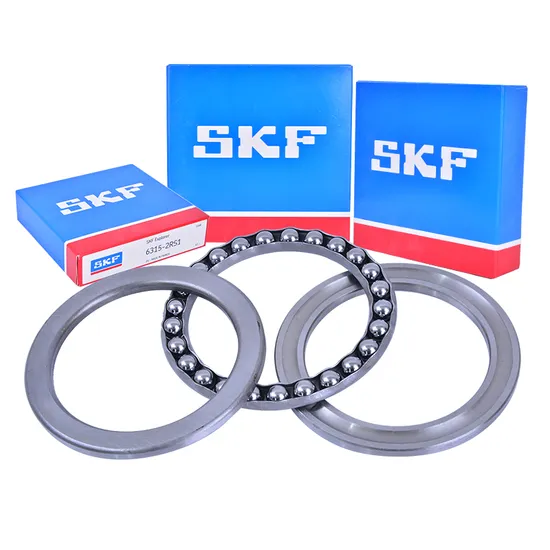 01 Thrust Ball Bearing Thrust Ball Bearing 51100-51104 for Agricultural Machinery with ISO9001 Certified Steel View model details
 02 Thrust Ball Bearing High Precision Thrust Ball Bearing 51100 10x24x9mm for Crane Hook with ISO9001 Certification View model details
 03 Thrust Ball Bearing High Speed Thrust Ball Bearing 51100 51102 51103 51104 for Industrial Machinery View model details
 04 Thrust Ball Bearing Thrust Ball Bearing 51118 51218 51318 51120 51220 with ISO9001, In Stock for Industrial Machinery View model details
Applications
Where these SKF bearings are used
Keep reading
Related SKF bearing selection guides
More practical notes on SKF designations, precision items and project bearing lists from Project Purchasing Company.
 Brands & Alternatives · · 8 min read SKF Ball Bearing Range: Wholesale Supplier for Bulk & MRO Orders Navigate the SKF ball bearing range with precision by mastering series specs, suffix codes, and compliant cross-brand alternatives. Optimize MRO procurement costs while ensuring… Read the guide
 Brands & Alternatives · · 8 min read Ball Bearing Brand Tiers for Motor Repair: Wholesale Supplier Ball Bearing Brand Tiers for motor repair help buyers avoid costly failures from inferior heat treatment and clearance control. Match Tier 1 or 2… Read the guide Brands & Alternatives · · 6 min read Old to New SKF Ball Bearing Designations Cross-Reference Chart for Wholesale Buyers Master the Old to New SKF Ball Bearing Designations Cross-Reference Chart for Wholesale Buyers to avoid catastrophic failures from hidden suffix mismatches. Learn why… Read the guide

Request a quote
Send your SKF list. Get one itemized written quote.
Project Purchasing Company supplies SKF ball, roller, precision and housed bearing units to distributors, repair workshops and project buyers worldwide. Standard and precision items are priced line by line, with accessories kept on the same quote.