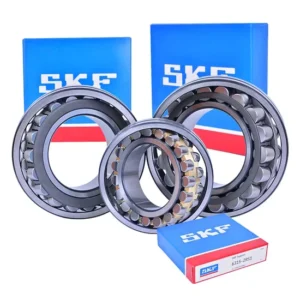
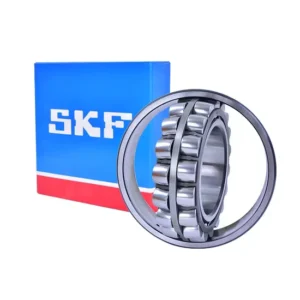
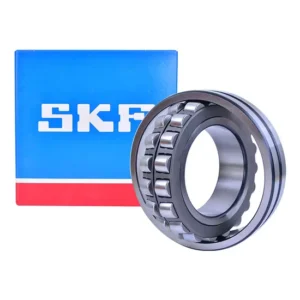
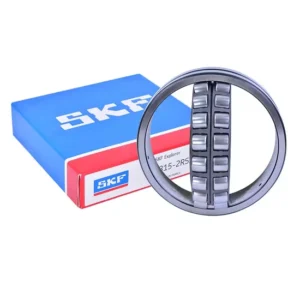
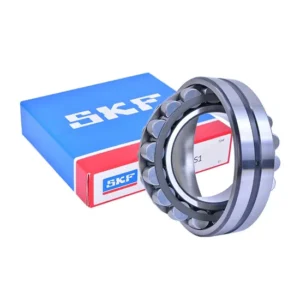
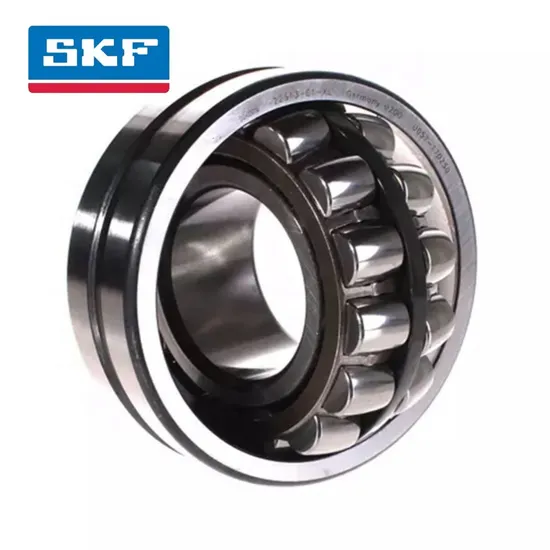
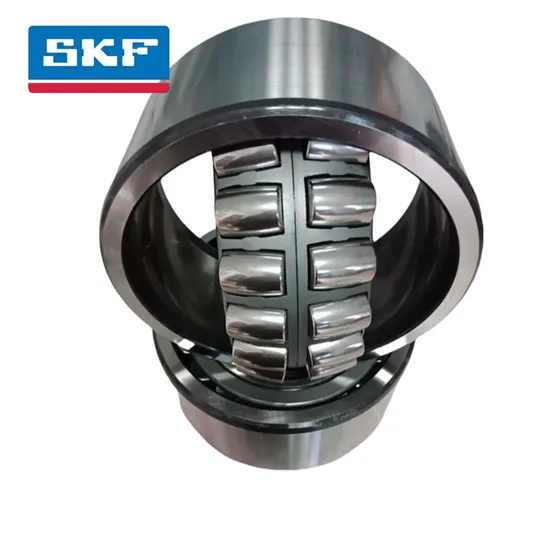
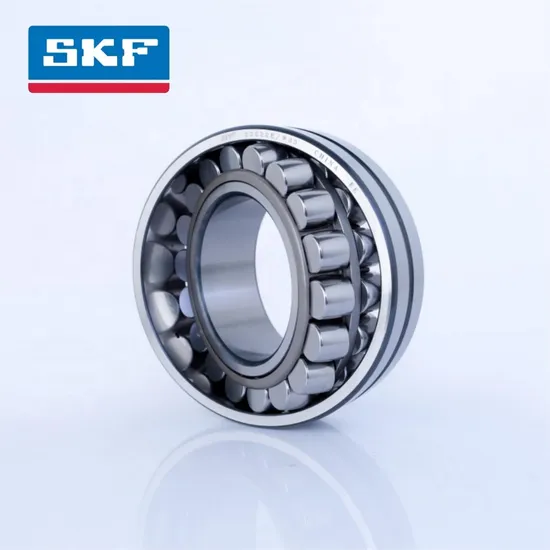
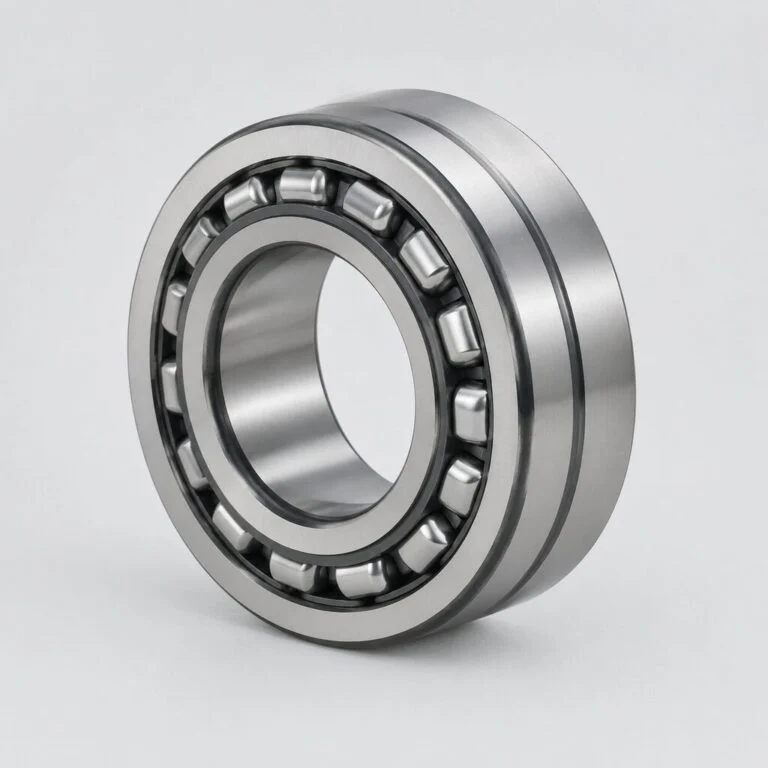
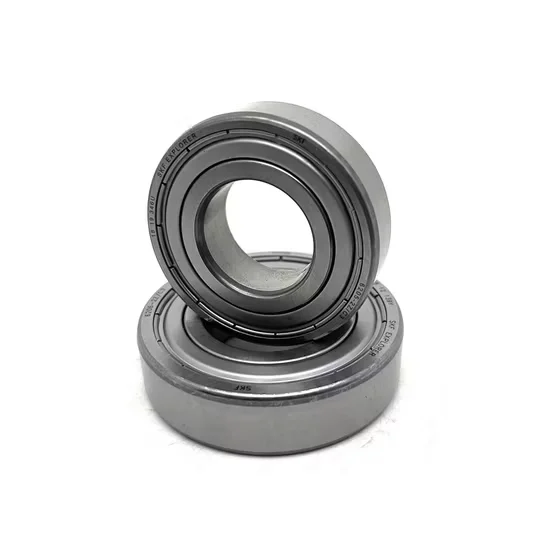
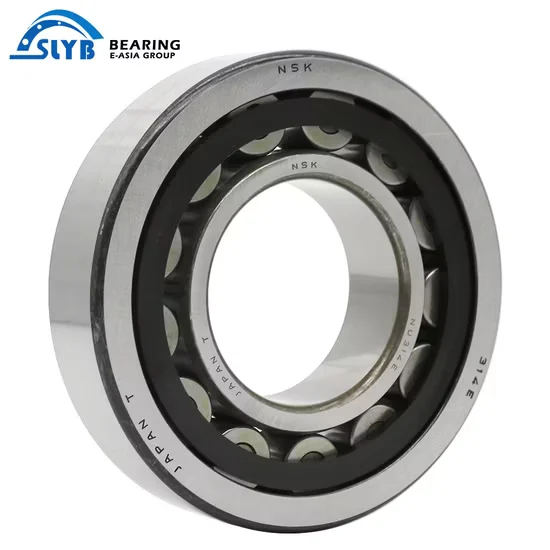
Listed data for this SKF designation; confirm the execution and dimensions against your drawing or application before ordering.
Scan-to-Verify Authenticity — Every NSK 24120CDKE4 2 spherical roller bearing we dispatch includes original factory QR codes for instant digital validation via the manufacturer's official application.
Technical Specifications
| Parameter | Value |
| Designation | NSK 24120CDKE4 2 |
| Bearing Type | Spherical Roller Bearing |
| Bore Diameter (d) | 100 mm |
| Outside Diameter (D) | 165 mm |
| Width (B) | 65 mm |
| Number of Rows | Double |
| Bore Type | 1:12 Taper Bore (K) |
| Material | Bearing Steel |
| Load Direction | Radial |
| Clearance Class | C0, C3, C4 |
| Origin | China |
Note: Suffixes CD and 4 require manufacturer catalog confirmation for specific internal design details.
Application Suitability
| Industry | Typical Applications |
| Mining | Vibrating screen exciter mechanisms, crusher main shafts |
| Steel Mills | Continuous casting machine guide rolls, rolling mill tables |
| Construction | Heavy-duty excavator slew drives, bulldozer track idlers |
| Paper Manufacturing | Paper machine dryer section felt rolls |
Why Thermal Expansion Dictates Clearance Selection for the NSK 24120CDKE4 2 spherical roller bearing
Ignoring operating temperature gradients during clearance specification inevitably leads to internal preload and catastrophic roller seizure.
When investigating premature failures in high-heat environments, I frequently encounter situations where standard clearance bearings were installed in equipment running at elevated temperatures. The thermal expansion of the shaft and housing compresses the internal gap, effectively locking the rolling elements. This misalignment between environmental reality and component specification causes a significant share of unplanned downtime in heavy industrial sectors. Procurement teams often default to standard options without calculating the exact thermal growth, resulting in repeated replacement cycles. Furthermore, the intense heat alters the lubricant viscosity, compounding the friction generated by the zero-clearance condition and accelerating surface fatigue across the raceways.

Aligning Component Geometry with Extreme Radial Demands
The primary function of the NSK 24120CDKE4 2 spherical roller bearing is to accommodate heavy radial loads while compensating for shaft deflection and housing misalignment. In rugged environments like mining and metallurgy, structural flexing is unavoidable under peak operational stresses. The double row configuration and self-aligning raceway geometry ensure that load distribution remains uniform across the rolling elements, preventing localized stress concentrations that would otherwise accelerate fatigue. Our consolidation service ensures these specific heavy-duty variants are readily available for urgent maintenance schedules, preventing extended equipment outages when critical machinery requires immediate intervention.
Navigating Contamination and Lubrication Starvation
Operating in dusty or slurry-rich environments introduces severe contamination risks that compromise lubricant film integrity. Particulate ingress acts as an abrasive paste, accelerating wear on the raceways and rolling elements. Maintaining an adequate lubrication regime is critical; oil circulation systems are often preferred over grease in high-speed or high-temperature applications to dissipate heat and flush away debris. Furthermore, the 1:12 taper bore requires precise mounting techniques to achieve the correct residual internal clearance, as over-tightening the locknut will eliminate the operational gap. Inadequate sealing in these harsh conditions allows microscopic abrasives to penetrate the load zone, drastically reducing the calculated service life.
Decoding the Internal Architecture and Bore Configuration
The K suffix indicates a 1:12 taper bore, which is essential for achieving precise radial internal clearance adjustment during mounting on adapter sleeves or tapered shafts. This design allows maintenance crews to measure the clearance reduction accurately as the bearing is driven up the taper. The E suffix denotes an enhanced internal design, typically featuring optimized roller profiles and increased load-carrying capacity for demanding operations. The unseparated construction and bearing steel material provide the structural rigidity necessary to withstand continuous shock loads without cage deformation. Selecting the appropriate clearance class—such as C4 for high-temperature continuous casting applications—is vital to compensate for thermal expansion and maintain optimal rolling kinematics under load.
The Financial Impact of Specification Mismatches
Selecting an incorrect clearance class or ignoring the taper bore mounting requirements leads to severe operational consequences. A bearing installed with insufficient residual clearance will experience excessive friction, generating rapid temperature spikes and eventual roller skidding. Conversely, excessive clearance causes vibration and poor load distribution. These failures often result in catastrophic damage to adjacent shafts and housings, voiding equipment warranties and triggering extended production halts that far exceed the component's initial procurement cost. The collateral damage to surrounding mechanical assemblies frequently transforms a routine maintenance task into a major structural rebuild, severely impacting overall plant profitability.
Securing Traceability and Technical Accuracy
Sourcing genuine components is critical when dealing with high-load applications where counterfeit materials fail unpredictably. We provide complete batch traceability documentation for every NSK 24120CDKE4 2 spherical roller bearing, ensuring the metallurgical properties match the manufacturer's original specifications. Our technical team assists in verifying cross-reference equivalents and selecting the correct clearance class based on your specific thermal calculations. We maintain massive spot inventory to support single-unit emergency shipments or full container consolidations, eliminating the delays associated with coordinating multiple suppliers for mixed-brand project orders. This comprehensive approach guarantees that the exact configuration required for your heavy machinery is dispatched rapidly and verified thoroughly before deployment.
Documentation & Authenticity Verification
- Original factory batch traceability certificates linking the specific serial number to the production date.
- Official QR code labels enabling instant digital authentication via the manufacturer's mobile application.
- Material and dimensional inspection reports confirming the 100 mm bore and 165 mm outside diameter tolerances.
- Certificate of Conformity validating the C0, C3, or C4 clearance class specifications prior to dispatch.
- Origin documentation confirming the manufacturing facility for customs and compliance requirements.
Storage, Handling & Mounting Protocols
- Retain the original vapor-phase inhibitor packaging until immediately before mounting to protect the bearing steel from humidity.
- Use induction heaters with automatic demagnetization for the 100 mm bore to prevent thermal shock during cylindrical shaft installations.
- Measure the radial internal clearance reduction continuously when driving the 1:12 taper bore up the adapter sleeve.
- Apply clean lint-free gloves when handling the unseparated double row assembly to prevent skin acids from initiating corrosion.
- Ensure the locknut is secured with the correct tab washer to prevent axial loosening under heavy vibrating screen loads.
Engineering Review and Selection Support
To ensure optimal performance and longevity, please provide detailed operational parameters including exact radial and axial loads, operating speeds, and ambient temperature ranges. Supplying the original equipment manufacturer part numbers allows our engineering team to perform precise cross-reference verification and L10 life calculations. Detailing the specific environmental conditions, such as exposure to abrasive dust or corrosive slurries, enables us to recommend the most suitable sealing arrangements and lubrication strategies for your application. Sharing historical failure data or previous maintenance logs further assists our specialists in identifying recurring issues and proposing engineered solutions that extend the mean time between failures.
Frequently Asked Questions
Q: How do the K and E suffixes affect the installation and performance of this component?
A: The K suffix designates a 1:12 taper bore, requiring the use of adapter sleeves or tapered shafts for precise clearance adjustment during mounting. The E suffix indicates an enhanced internal geometry designed to increase load-carrying capacity and improve roller guidance, making it highly suitable for heavy-duty industrial machinery experiencing significant radial forces.
Q: What is the procedure for verifying the authenticity of the received bearings?
A: Each unit features original factory QR codes that can be scanned using the manufacturer's official mobile application. This digital verification confirms the production batch, manufacturing facility, and original specifications. We also supply comprehensive batch traceability documentation and dimensional inspection reports to validate the component's origin and physical tolerances before installation.
Q: How should clearance classes like C3 and C4 be selected for high-temperature environments?
A: In applications with significant thermal gradients, such as steel mill continuous casters, standard clearance may compress to zero due to shaft and housing expansion. Selecting a C3 or C4 clearance class provides the necessary initial gap to accommodate this thermal growth, ensuring a positive operational clearance is maintained at operating temperature to prevent roller seizure and premature failure.
Q: What cross-reference considerations are necessary when replacing existing bearings?
A: When substituting components, it is crucial to verify not just the basic boundary dimensions but also the internal design, cage material, and exact clearance class. Our technical team can cross-reference equivalent models from other premium global brands, ensuring that the replacement matches the original equipment's load capacity, speed limits, and misalignment compensation requirements.
Q: How do ISO standards apply to the precision and failure analysis of these bearings?
A: ISO 492 defines the dimensional and geometrical tolerances for radial bearings, ensuring the 100 mm bore and 165 mm outside diameter meet strict limits. For failure analysis, ISO 15243 provides a standardized classification system for damage and failure modes, helping maintenance teams identify root causes such as lubrication starvation, contamination, or incorrect mounting procedures.