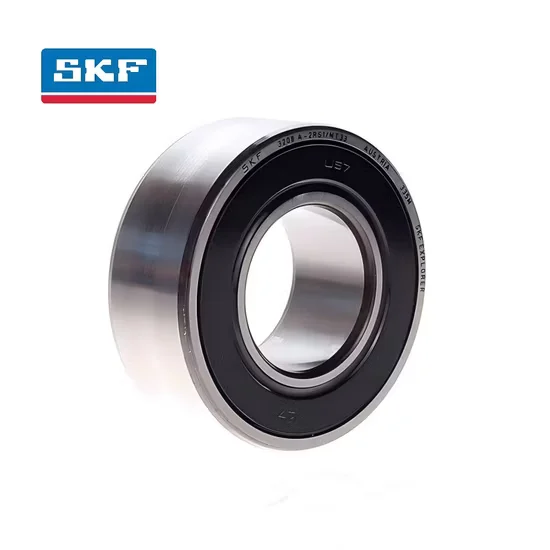
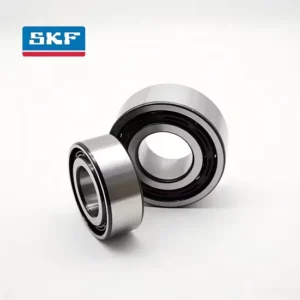
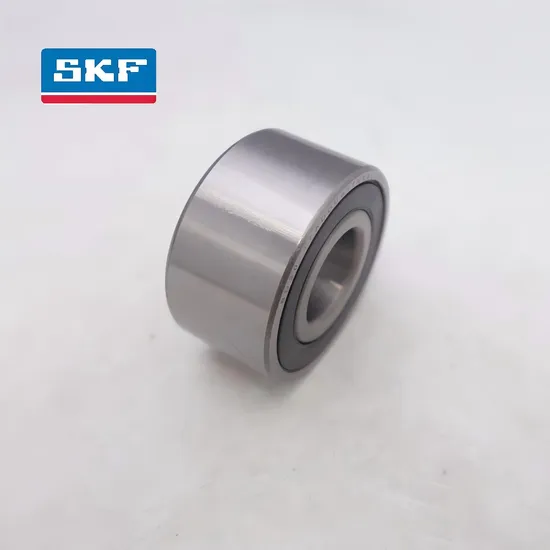
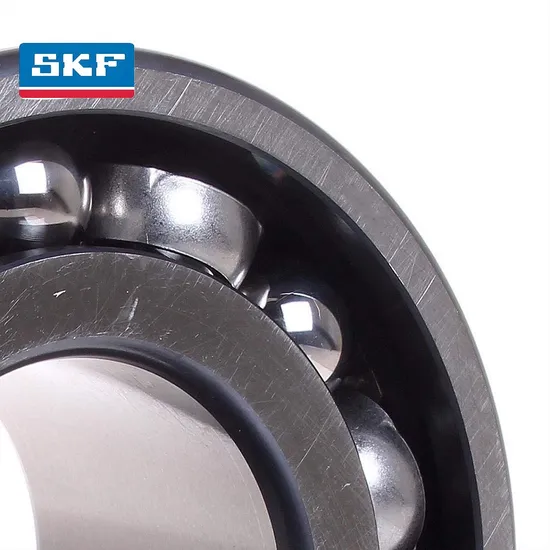
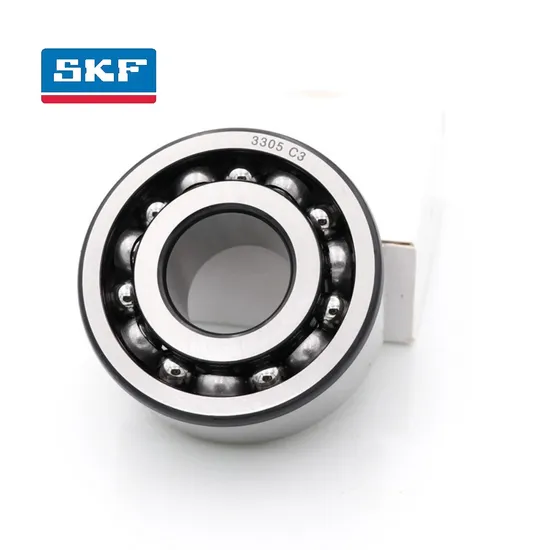
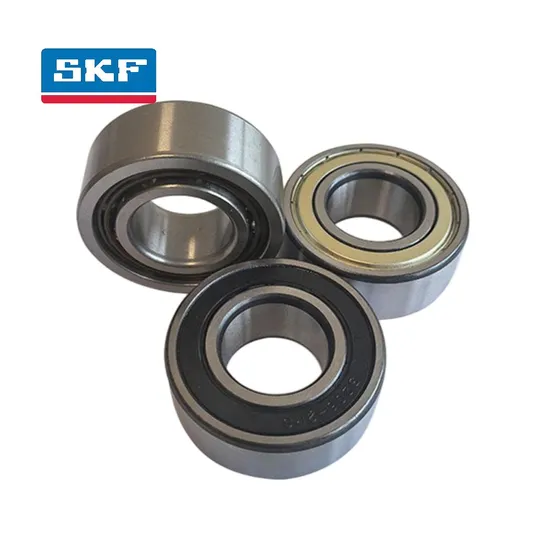
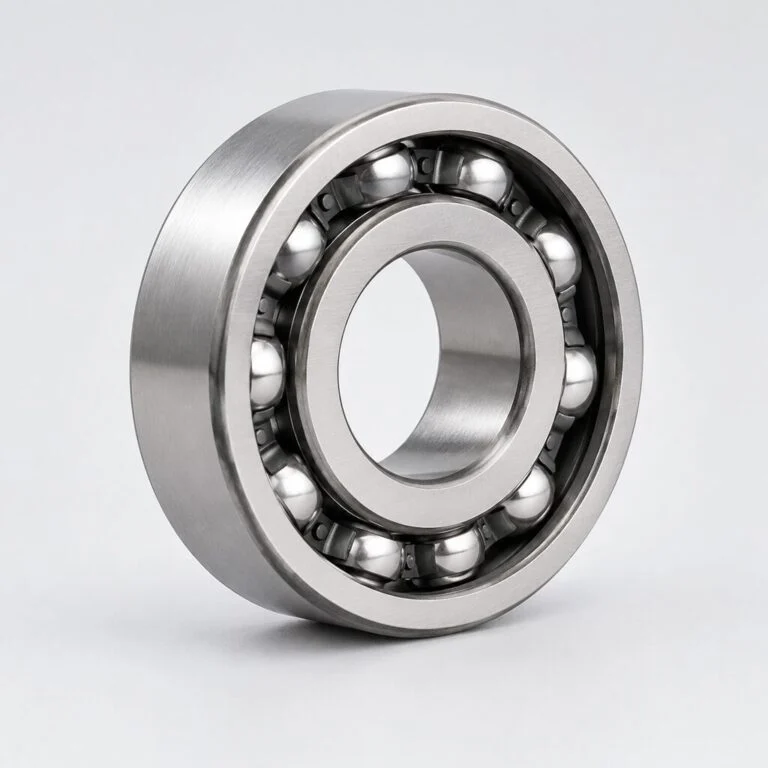
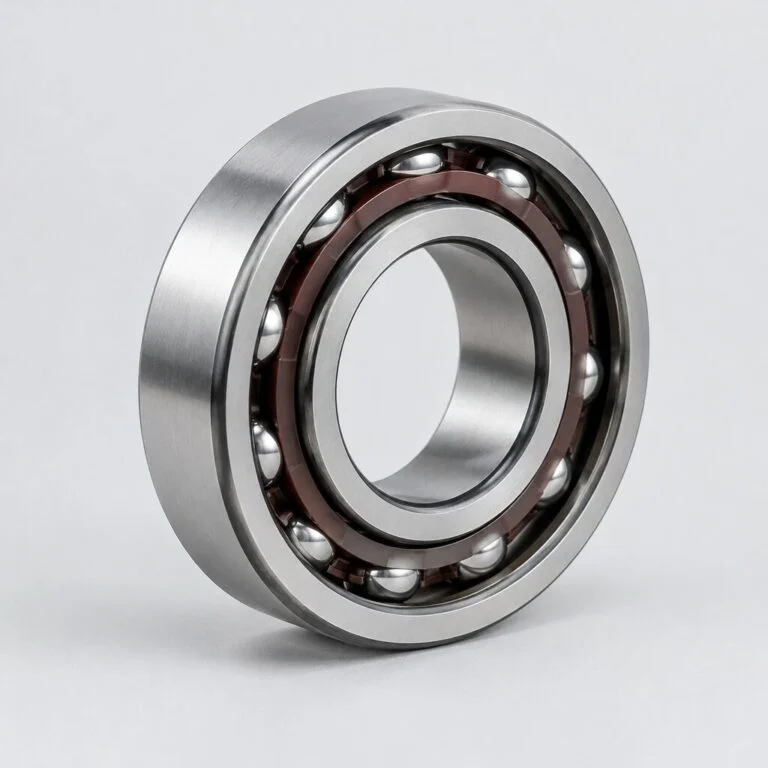
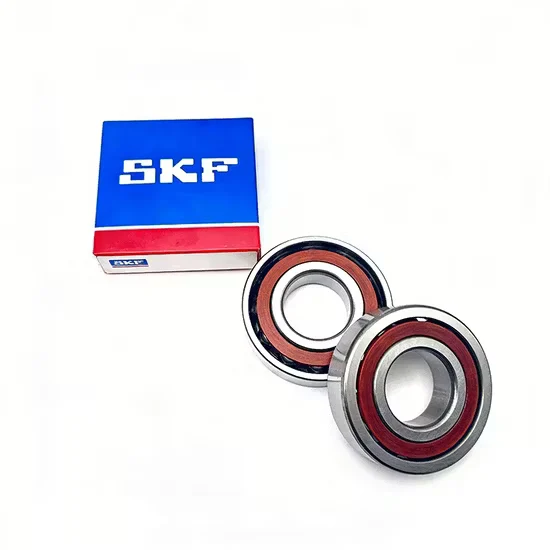
Listed data for this SKF designation; confirm the execution and dimensions against your drawing or application before ordering.
Official App QR Verification — Every SKF 3211-a Tn9 double row angular contact ball bearing we dispatch includes a scannable QR code linked directly to the manufacturer's authentication database.
Technical Specifications
| Parameter | Value |
| Designation | SKF 3211-a Tn9 |
| Bearing Type | Double Row Angular Contact Ball Bearing |
| Bore Diameter (d) | 55 mm |
| Outside Diameter (D) | 100 mm |
| Width (B) | 33.3 mm |
| Dynamic Load Rating (C) | 60 kN |
| Static Load Rating (C₀) | 47.5 kN |
| Limiting Speed | 6300 r/min |
| Cage Material | Glass Fibre Reinforced Polyamide |
| Seal or Shield Type | Open |
| Precision Class | P0 / P2 / P4 / P5 / P6 |
| Contact Angle | 30° |
| Material | Bearing Steel |
| Origin | Jiangsu China |
-a: unverified suffix — requires manufacturer catalog confirmation.
Application Suitability
| Industry | Typical Applications |
| Machine Tool Manufacturing | Spindle support mechanisms requiring high radial and axial rigidity |
| Industrial Pump Systems | High-speed impeller shafts handling combined load profiles |
| Robotics & Automation | Articulation joints demanding precise rotational accuracy |
Why Polyamide Cages Fail in High-Vibration Gearboxes
Material resonance often destroys the cage long before the rolling elements fatigue.
When sourcing a SKF 3211-a Tn9 double row angular contact ball bearing for heavy machinery, engineers frequently overlook how cage material interacts with specific vibration frequencies. I have seen glass fibre reinforced polyamide cages shatter inside industrial gearboxes simply because the operational resonance exceeded the polymer's structural limits, leading to sudden shaft lockups. The double row design inherently increases the mass and contact points, which can amplify harmonic vibrations if the housing rigidity is insufficient. Many maintenance teams misdiagnose this as a lubrication failure, replacing the unit with the exact same polymer-caged variant, only to experience repeated catastrophic seizures within months. Understanding the precise dynamic environment is crucial before finalizing the cage material specification.

Matching the 30° Contact Angle to Combined Loads
The 30° contact angle integrated into this SKF 3211-a Tn9 double row angular contact ball bearing provides an optimal balance for applications experiencing simultaneous radial and axial forces. By distributing the load across a wider raceway contact ellipse, the bearing maintains rigidity in machine tool spindles where axial thrust from cutting tools constantly challenges shaft alignment. Our engineering team regularly cross-references these load vectors against your specific machining parameters to prevent premature raceway spalling. Unlike single row variants that require complex paired arrangements to handle bidirectional thrust, this double row configuration acts as a single rigid unit, significantly simplifying the housing design while delivering the necessary axial stiffness for precision equipment.
Navigating Thermal Expansion and Lubrication Starvation
High-speed pump applications generate substantial internal friction, demanding a cage material that minimizes heat generation while maintaining structural integrity. The polyamide cage reduces sliding friction compared to brass alternatives, yet it requires careful monitoring of lubrication intervals to prevent thermal degradation. Furthermore, the non-aligning design means any shaft deflection directly transfers to the raceway edges, making precise housing tolerances and correct initial clearance selection absolutely critical for long-term reliability. If the operating temperature fluctuates wildly, the differential thermal expansion between the steel rings and the polymer cage can alter the internal clearance, potentially leading to excessive preload and accelerated wear. Proper oil or grease selection must account for these specific thermal dynamics to ensure the polyamide structure remains stable throughout the operational lifecycle.
Decoding the TN9 Cage and Precision Ratings
The TN9 suffix indicates a glass fibre reinforced polyamide 66 cage, which offers excellent high-speed capability and low noise operation, though it has strict temperature boundaries compared to machined brass. The 30° contact angle ensures the bearing can handle significant axial loads in one direction while supporting radial loads, functioning essentially as two back-to-back single row bearings in a compact footprint. Precision ratings ranging from P0 to P6 dictate the running accuracy, where tighter tolerances are mandatory for robotics to eliminate micro-vibrations during high-speed articulation. The separated design of the bearing components allows for independent inspection of the inner and outer rings, ensuring that the raceway geometry perfectly matches the required precision class before assembly. Selecting the correct precision grade directly influences the rotational smoothness and the overall lifespan of the spindle mechanism.
The True Cost of Ignoring Cage Material Limits
Selecting a polyamide cage for an application with severe vibration or chemical exposure often results in catastrophic cage fragmentation, completely voiding the equipment warranty. According to ISO 15243 frameworks, cage failure is classified as a secondary damage mode that rapidly escalates into rolling element seizure and shaft scoring. This unplanned downtime in a continuous production line easily eclipses the initial cost savings of choosing a standard polymer cage over a specialized brass alternative. When the cage breaks apart, the rolling elements lose their precise spacing, causing them to cluster and skid against the raceway, which generates immense localized heat and destroys the bearing steel's hardened microstructure. Replacing the bearing is only a fraction of the cost; machining a new shaft and repairing the damaged housing represents the true financial burden.
Securing Authentic Traceability for Critical Components
Counterfeit bearings frequently use substandard polymers for the TN9 cage, which melt under normal operating temperatures. We mitigate this risk by providing complete batch traceability and official app QR verification for every SKF 3211-a Tn9 double row angular contact ball bearing we supply. Our technical team also reviews your specific vibration profiles to confirm whether the polyamide cage is genuinely suitable, or if a cross-reference to a brass-caged equivalent is necessary to prevent field failures. Because we maintain massive spot inventory across multiple global brands, we can quickly pivot to an alternative manufacturer's brass-caged double row angular contact bearing if your application parameters dictate a change in material. This flexibility ensures your machinery receives the exact component it needs, backed by genuine documentation and rigorous quality assurance protocols.
Documentation & Authenticity
- Certificate of Conformity verifying the exact production batch of the polyamide cage material.
- Official app QR code validation confirming genuine manufacturer origin before installation.
- Dimensional inspection reports confirming the 30° contact angle and P-class tolerances.
- Material traceability documents linking the bearing steel to specific heat treatment lots.
Storage, Handling & Mounting
- Store the polyamide caged bearings away from direct UV light to prevent polymer degradation before mounting.
- Use induction heating for the inner ring, keeping temperatures below the thermal limit of the TN9 cage.
- Keep the original packaging sealed to protect the precision-ground raceways from ambient moisture and dust.
- Avoid using harsh chemical solvents during cleaning, as they can compromise the glass fibre reinforced polyamide structure.
Engineering Review for Your Specific Application
To ensure this bearing meets your operational demands, please provide the exact radial and axial load profiles, operational speeds, and ambient temperature ranges. Our technical team will calculate the L10 life and verify if the polyamide cage material aligns with your vibration environment. If you are replacing an existing unit, sharing the OEM equipment number allows us to perform a precise cross-reference check. We also need details regarding your lubrication method and sealing requirements to confirm that the open or shielded configuration will adequately protect the internal components from environmental contaminants, ensuring maximum service life in your specific facility.
Frequently Asked Questions
Q: How does the TN9 polyamide cage perform compared to brass in high-vibration gearboxes?
A: The TN9 glass fibre reinforced polyamide cage excels in high-speed, low-vibration environments by reducing friction and noise. However, in gearboxes with severe structural resonance, brass cages are generally preferred because polymers can suffer from fatigue cracking under continuous high-amplitude vibrations, leading to sudden cage fragmentation and bearing seizure.
Q: What are the cross-reference considerations when replacing this model?
A: When cross-referencing to equivalent models from other premium brands, you must verify that the 30° contact angle and the polyamide cage material match exactly. Substituting a brass-caged variant without adjusting the housing tolerances or lubrication intervals can alter the internal clearance and thermal behavior, potentially reducing the overall service life.
Q: How can I verify the authenticity of the bearing upon delivery?
A: Every genuine unit we supply features a unique QR code on the packaging that links directly to the manufacturer's official authentication database. By scanning this code with the official app, you can instantly verify the production batch, origin facility, and confirm that the bearing has not been altered or counterfeited during transit.
Q: What mounting tools are recommended for this double row angular contact bearing?
A: We recommend using calibrated induction heaters for the inner ring, strictly monitoring the temperature to avoid exceeding the thermal limits of the TN9 polyamide cage. Additionally, mechanical or hydraulic mounting tools should apply force exclusively to the inner ring, preventing any axial load transfer through the rolling elements during installation.