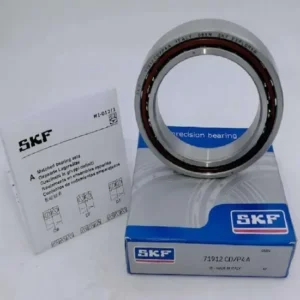
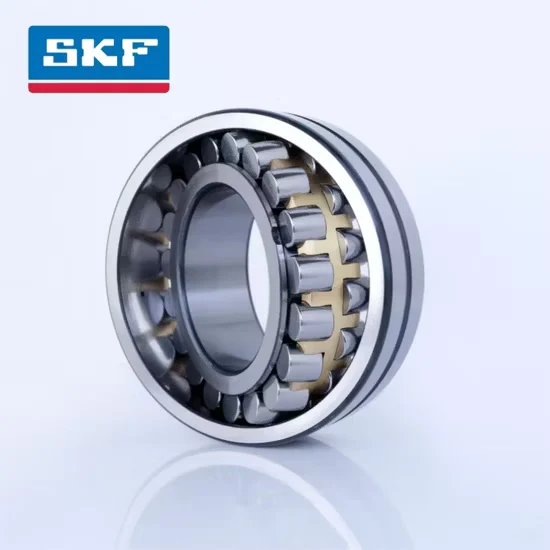
Listed data for this SKF designation; confirm the execution and dimensions against your drawing or application before ordering.
Authorized Channel Procurement — Every 7010ACD/P4ADBD batch ships with traceable distributor documentation and verifiable origin files, matching the exact ISO 492 tolerance demands of high-speed spindles and marine turbo assemblies.
Technical Specifications
| Parameter | Value |
| Designation | SKF 7010ACD/P4ADBD |
| Bearing Type | Angular Contact Ball Bearing |
| Number of Rows | Single Row |
| Bore Diameter (d) | 50 mm |
| Contact Angle | 25° (ACD designation) |
| Precision Class | P4 (ISO tolerance class 4 per ISO 492) |
| Arrangement | ADBD pairing |
| Weight | 0.100 kg |
| Origin | China |
Note: The ADBD suffix in the 7010ACD/P4ADBD designation requires manufacturer catalog confirmation to determine the exact pairing configuration and preload class. Contact us with the full suffix string before finalizing procurement.
Application Suitability
| Industry | Typical Applications |
| Industrial Machinery | CNC spindle main shaft, grinding wheel headstock |
| Marine | Turbocharger rotor shaft support, auxiliary power unit bearings |
| Precision Equipment | Coordinate measuring machine rotary axis, high-speed pump impeller shaft |
| Automotive & Heavy Vehicle | Turbocharger rebuild kits for commercial diesel engines |
What a 15° vs 25° Contact Angle Gets Wrong on a Turbo Rotor
The SKF 7010ACD/P4ADBD angular contact ball bearing carries a 25° contact angle that delivers the axial rigidity turbocharger and spindle applications demand — and substituting a 15° variant will not hold the thrust load.
A shipyard in Batam once matched a 7010 base number for a marine turbo rebuild but installed a standard P0 single-row bearing without checking the precision class or pairing suffix. At operational RPM the shaft ran hot within hours, the cage cracked, and the rotor seized mid-sea trial. The root cause was a combination of insufficient precision and wrong contact angle under combined radial-thrust loading. Counterfeit bearings with cloned QR codes and soft inner rings have been intercepted in multiple regional supply chains, and they fail silently — passing casual inspection but collapsing under sustained high-speed operation.

Matching the SKF 7010ACD/P4ADBD to High-Speed Rotary Equipment
The SKF 7010ACD/P4ADBD angular contact ball bearing performs where combined radial and axial loads meet tight dimensional tolerances. The 25° contact angle handles thrust components from turbine or spindle thrust collars that a 15° design simply cannot manage without excessive ball skidding. In our sourcing work, we have seen procurement engineers match the bore and OD correctly but overlook the P4 requirement — installing P5 or P6 in spindle applications and discovering runout issues only after the machine is commissioned. When cross-referencing across brands, we match contact angle, precision class, cage material, and preload arrangement together, not just the base designation number.
Operating Conditions That Define Precision Bearing Survival
Turbocharger and spindle environments stack multiple stresses: sustained high RPM generates friction heat that expands the inner ring and reduces internal clearance, while thrust loads from impellers or cutting forces act continuously in one direction. Temperature gradients between the inner and outer rings can shift the effective contact angle and preload state during warmup. Lubrication selection — oil-air versus grease pack — directly affects achievable speed and heat generation at P4 precision. Installation alignment is equally critical: even slight misalignment in the housing bore induces edge loading on the balls and accelerates cage wear.
Decoding What the Suffix String Actually Means
The ACD designation specifies a 25° contact angle with optimized internal geometry, giving this bearing higher axial capacity than its 15° ACD counterparts while maintaining acceptable radial load capability. P4 precision meets ISO 492 class 4 requirements, delivering tighter bore, OD, and running accuracy tolerances than P5 — essential for minimizing vibration and runout in spindle applications running at sustained high speeds. The single-row angular contact structure is designed to carry axial load in one direction, which is why these bearings are almost always installed in pairs with a defined preload arrangement.
When a Wrong Suffix Turns Into a Warranty Nightmare
Correct precision and contact angle selection backed by a traceable supply chain keeps equipment running to its designed L10 life. A mismatched clearance or lower precision class in a high-speed application leads to thermal binding, premature cage failure, or catastrophic shaft damage — costs that include unplanned downtime, replacement parts, and potential warranty voidance on the turbocharger or spindle assembly. Counterfeit bearings introduce a different risk entirely: soft rings that pass visual inspection but lack the hardness and metallurgical integrity needed for P4-class service, failing without warning under load.
How We Keep the Supply Chain Honest
Every SKF 7010ACD/P4ADBD we source moves through authorized distributor channels with full batch traceability. Buyers receive QR code verification pathways through the SKF official app so authenticity can be confirmed before installation, not after a failure. Our cross-reference database matches not just base numbers but contact angle, precision suffixes, cage materials, and preload arrangements across SKF, NSK, FAG, TIMKEN, NTN, and KOYO — so substitutions are made with engineering confidence. We provide application-based selection guidance when the operating conditions involve unusual speed, temperature, or load combinations. Country-of-origin documentation accompanies every shipment for import clearance, and dimensional inspection reports confirm P4 running accuracy before the bearing leaves our facility.
Documentation & Authenticity
- Supplier Certificate of Conformity with batch and lot traceability specific to each SKF 7010ACD/P4ADBD shipment
- QR code verification pathway via the SKF official app for authenticity confirmation before mounting
- Third-party runout and dimensional inspection confirming P4 tolerance class compliance
- Country-of-origin documentation package for import clearance and buyer-side verification
- HS code support for customs classification of precision angular contact bearings
Storage, Handling & Mounting
- Keep the SKF 7010ACD/P4ADBD in its original sealed packaging until the moment of installation — opening early exposes P4-precision raceways to particulate contamination that compromises running accuracy
- Matched pair sets must remain sealed together; separating them risks losing factory pairing marks required for correct ADBD arrangement during mounting
- Mounting should use controlled induction heating for the inner ring — never direct flame — to preserve the 25° contact angle geometry and P4 dimensional accuracy
- Clean gloves are mandatory when handling the bearing; skin oils on P4-grade raceways initiate corrosion that accelerates spalling under high-speed operation
- Verify housing bore alignment with a dial indicator before pressing in; angular contact bearings at P4 precision have minimal tolerance for misalignment
Before You Request a Quote
Share your application parameters — operating speed, load type and magnitude, temperature range, and lubrication method — so we can verify that the 7010ACD/P4ADBD suffix configuration is correct for your equipment. If you are replacing an existing bearing, provide the full designation from the nameplate including all suffixes, and we will cross-reference across brands with clearance, cage, and precision alignment. Request the documentation package and origin confirmation early in the process to align with your import timeline. Confirm batch availability and lead time for this precision-grade configuration before finalizing your procurement schedule.
Frequently Asked Questions
Q: How do I verify the authenticity of a SKF 7010ACD/P4ADBD bearing?
A: Use the QR code on the bearing packaging to verify through the SKF official app. Additionally, request the Certificate of Conformity and batch traceability documentation from your supplier. Authentic bearings from authorized channels include lot-level traceability that can be cross-checked against manufacturer records.
Q: What does the ADBD suffix mean on this bearing?
A: The ADBD suffix relates to the bearing pairing arrangement and preload specification. The exact configuration for this designation should be confirmed against the manufacturer's current catalog before procurement, as pairing suffixes define how matched sets are oriented and preloaded during installation.
Q: When should I choose P4 over P5 or P6 precision for a spindle application?
A: P4 precision is specified for applications requiring minimal runout and high rotational accuracy, such as machine tool spindles and high-speed turbocharger rotors. P5 or P6 may suffice for general-purpose applications, but in precision equipment, the tighter tolerances of P4 directly affect vibration levels, surface finish quality, and operational speed capability.
Q: Can I substitute this bearing with another brand's equivalent?
A: Cross-brand substitution is possible but requires matching not only the base number (7010) but also the contact angle (25°), precision class (P4), pairing arrangement, and cage material. A mismatch in any of these parameters can cause thermal binding or premature failure. We provide complete cross-reference comparisons across six major brands to ensure equivalence.
Q: What documentation comes with a high-precision angular contact bearing order?
A: Standard documentation includes a Certificate of Conformity with batch traceability, dimensional inspection reports, and country-of-origin files. Material certificates and third-party inspection reports can be arranged based on buyer requirements for import clearance and quality assurance.
Confirm Your 7010ACD/P4ADBD Configuration Today
Send us your full equipment designation or operating parameters, and we will return a verified cross-reference with matching precision, contact angle, and pairing arrangement — plus complete traceability documentation.
Contact us through your procurement channel to begin the technical review.