
Custom OEM SKF-Spec Bearings for Electric Motor Production Supplier
Model interchange alone is the single biggest trap in motor OEM bearing procurement. When spec’ing custom OEM SKF-spec bearings for electric motors, matching the outer dimensions is merely the entry ticket; the real performance variables—radial internal clearance group, sealing friction torque, and grease fill percentage—must be validated against the motor’s actual load, speed, and thermal profile, or the assembly will fail vibration testing before it leaves the factory floor.
I still remember the shipment that nearly sank my first year in the business. A Latin American motor manufacturer sent us a drawing calling for a deep groove ball bearing dimensionally identical to a 6205-2RZ. The factory ran the order to standard CN clearance and standard grease fill, shipped a full container, and waited. Weeks later, the motors hit the assembly line in São Paulo, and the vibration readings spiked across the board. The entire batch was rejected. The return freight alone consumed a mid-six-figure chunk of margin, and the rework labor back at the customer’s plant cost several times that. The root cause was not the steel, not the roundness, not the raceway finish—it was a C3 clearance mismatch that the drawing never explicitly flagged, combined with a grease fill that was too aggressive for the motor’s pole count and RPM. That single oversight turned what should have been a routine reorder into a logistics nightmare.
From that point on, every custom OEM SKF-spec bearings order I touch gets dissected layer by layer before a single ring is ground. What follows is the framework we now use to make sure the same mistake never repeats.
Why Model Interchange Alone Fails in Motor OEM Applications?
A bearing that fits the shaft and housing dimensionally can still destroy a motor’s NVH performance if the internal parameters are not matched to the operating envelope. The interchange mentality comes from a place of convenience: if the outer diameter, bore, and width match the reference part, procurement assumes the job is done. In reality, the reference part’s suffix codes carry the real engineering intent, and those suffixes are routinely ignored on purchase orders.
Consider what a suffix chain actually encodes. The clearance group (CN, C3, C4) dictates how much radial play exists at room temperature versus operating temperature. The seal type (2RS, 2RZ, Z) controls contamination ingress and friction torque. The grease fill (often expressed as a percentage of free space) determines thermal behavior at speed. The vibration grade (Z1V1, Z2V2, Z3V3 per ABMA/ISO standards) sets the acoustic floor. Strip any one of these away and you are no longer ordering the same bearing—you are ordering a different product that happens to share a footprint.
A Southeast Asian fan motor customer once placed an order for a sealed variant without specifying the suffix precisely. The factory supplied a standard 2RS design where the application actually needed a low-torque 2RZ variant. The result was not immediate failure; it was a slow, insidious leak. The lip seal’s higher friction generated enough heat to thin the grease, which then migrated past the winding insulation. Within months, a noticeable proportion of motors in the field showed winding contamination, and the scrap cost per unit was several times the bearing price itself. The bearing had "interchanged" perfectly. The motor had not.
How to Match Bearing Clearance to Motor Load and Speed?
Radial internal clearance is not a fixed property you copy from a catalog—it is a dynamic state that shifts with thermal expansion, and the correct group must be selected based on the motor’s specific load-speed-temperature triangle. The common mistake is to default to CN (normal) clearance because the reference drawing says so, without asking whether the motor’s operating temperature will consume that clearance entirely.
The logic chain is straightforward. At startup, the inner ring heats faster than the outer ring because it is closer to the heat source and rotating under load. This differential expansion reduces the radial clearance that existed at room temperature. If the initial clearance is too tight, the bearing ends up preloaded at operating temperature, which drives up friction, temperature, and vibration. If the initial clearance is too loose, the rolling elements skid under light load, generating noise and accelerating cage wear.
For standard induction motors running at moderate speeds and loads, CN is often adequate. For high-speed spindle motors or motors operating in hot environments, a C3 or even C4 group is typically required to preserve residual clearance at thermal equilibrium. For slow-speed, heavily loaded applications such as certain pump or conveyor drives, CN or even a C2 group may be preferable to maintain rigidity. The selection is never arbitrary; it is a function of the motor’s thermal model.
A Middle East water pump motor manufacturer learned this the hard way. Their reference drawing specified a particular clearance group suited to a European ambient temperature profile. When the same bearing was installed in motors operating under desert ambient conditions with elevated internal temperatures, the clearance was consumed entirely, preload developed, and the bearing temperature rose well above the design limit. The fix was not a different bearing type—it was a shift to a higher clearance group that preserved adequate play at the actual operating temperature.
Which Sealing Type Fits Your Motor Environment?
The seal suffix is not a cosmetic choice—it defines the contamination protection level, the friction torque contribution, and the thermal behavior of the entire bearing arrangement. The three common variants for deep groove ball bearings in motor applications are the contact rubber seal (2RS), the low-friction non-contact seal (2RZ), and the metal shield (Z or 2Z). Each has a distinct physics profile.
The 2RS contact seal provides the highest level of contamination exclusion and grease retention. The lip rides on the inner ring shoulder, creating a physical barrier. The trade-off is friction torque: the lip contact generates heat, which can be significant at higher speeds. This makes 2RS ideal for low-to-medium speed motors in dusty or washdown environments, but potentially problematic for high-speed designs where thermal management is already tight.
The 2RZ non-contact seal offers a compromise. The gap between the seal and the inner ring is small enough to deflect larger particles but large enough to avoid continuous contact friction. Friction torque is noticeably lower, making it suitable for higher-speed motors. However, the protection level against fine dust or moisture ingress is inherently lower than a contact seal.
The Z (metal shield) design provides basic protection against large particles and grease retention, with the lowest friction torque of the three. It is commonly used in motors where the external environment is controlled and the primary concern is keeping the grease in rather than keeping contaminants out.
The selection must be driven by the motor’s actual contamination exposure and speed profile, not by habit. A fan motor running at high RPM in a clean indoor environment has no business running a 2RS seal—the friction penalty is pure waste. A conveyor drive in a mining environment has no business running a Z shield—the contamination ingress will destroy the grease in a fraction of the expected service life.
What Grease Fill Level Prevents Motor Overheating?
Grease fill is the most silently destructive variable in motor bearing specification—too much churns and overheats, too little starves and wears, and the correct percentage depends directly on the motor’s speed and pole configuration. The industry default is often to fill the bearing cavity completely during assembly, on the assumption that more lubricant equals longer life. In a motor application, this assumption is backwards.
At speed, the rolling elements and cage churn the grease. If the cavity is overfilled, the churning generates viscous drag, which converts directly into heat. The heat raises the grease temperature, which lowers its viscosity, which accelerates oxidation and bleed-out. The grease degrades far faster than it would in a correctly filled bearing, and the bearing temperature rises to the point where the motor’s thermal protection may trip or the winding insulation may be compromised.
The generally accepted fill range for electric motor bearings is between a fifth and a third of the free cavity space, with the exact point depending on speed. For high-speed motors (typically those with two or four poles running at three thousand RPM or above on a fifty Hertz supply), the fill should be at the lower end of that range—closer to a fifth. For lower-speed motors (six or eight poles, running at fifteen hundred RPM or below), a fill closer to a third is appropriate because the churning speed is lower and the risk of starvation is higher.
The grease type itself is equally critical. A polyurea-thickened grease designed for high-speed electric motor bearings will behave very differently from a lithium-complex grease designed for heavy-load industrial applications. Substituting one for the other without validating the speed factor and temperature range can lead to premature grease failure even if the fill percentage is correct.
A Southeast Asian manufacturer of fractional-horsepower fan motors once specified a grease fill that was appropriate for a four-pole motor but applied it unchanged to a two-pole variant running at double the speed. The bearing temperature in the two-pole motors rose noticeably above the design target, and field returns began to accumulate within the first year of service. The root cause was not the grease chemistry—it was the fill volume, which was simply too aggressive for the higher churning speed. Reducing the fill to the lower end of the acceptable range brought the temperature back within specification without changing the grease or the bearing type.
How to Validate OEM Drawings Before Mass Production?
The only reliable defense against specification mismatch is a structured drawing audit that treats every suffix code as a load-bearing parameter, not a clerical detail. The audit must happen before tooling is committed, before the first sample is run, and before the purchase order is released for production. The cost of a two-week delay for sample validation is trivial compared to the cost of a container shipped across an ocean and returned in rejection.
The audit checklist should cover, at minimum, the following parameters in explicit written form: the base model designation; the radial internal clearance group (CN, C2, C3, or C4); the seal or shield type (2RS, 2RZ, Z, or open); the vibration grade (Z1V1 through Z3V3 per ABMA/ISO standards); the grease type and its compatible speed-temperature range; and the grease fill percentage relative to the free cavity space. If any of these fields is blank on the drawing, it must be filled by explicit agreement with the customer before production begins—not assumed, not defaulted, not left to the factory’s interpretation.
In our own workflow, every custom OEM SKF-spec bearings order goes through a formal sample approval loop. We produce a small batch to the fully specified drawing, run first-article inspection including vibration testing on a calibrated bench, and ship the samples to the customer for installation validation in the actual motor. Only after written sign-off on the samples does the production order proceed. This process has caught clearance mismatches, seal friction issues, and grease fill problems before they could become shipping-container problems.
A European industrial motor OEM once sent us a drawing that specified a vibration grade but left the grease fill field blank. We flagged it, produced samples at two different fill levels, and sent both sets for the customer’s evaluation. The higher fill level produced acceptable vibration at low speed but exceeded the temperature limit at the motor’s rated continuous duty. The lower fill level passed both tests. The drawing was revised, the correct fill was locked in, and the production order ran without a single field complaint. That two-week sample loop saved what would otherwise have been a mid-six-figure warranty exposure.
Conclusion
Dimensional interchange is the cheapest part of a motor bearing specification; clearance, sealing, and grease fill are the variables that actually determine whether the motor passes vibration testing and survives its design life. Treating a bearing drawing as a complete specification when it only defines the outer envelope is the single most expensive shortcut in motor OEM procurement. Validating every suffix parameter through sample testing before production release is not a delay—it is the only insurance policy that matters.
Products in this article
SKF bearings mentioned above
 01 Clutch Release Bearings LM501349/LM501310 501349/10 Double Row Roller Bearing OEM View model details
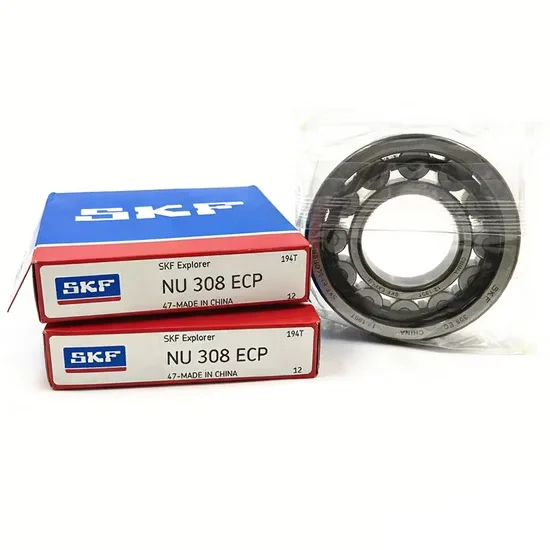 02 Cylindrical Roller Bearings SKF NU308ECP Cylindrical Roller Bearing for Gearbox Reducer OEM View model details
 03 Deep Groove Ball Bearings Genuine SKF Deep Groove Ball Bearings 6201-6206 OEM ODM Supply View model details
 04 Tapered Roller Bearing SKF 32218 Conical Roller Bearing 90x160x42.5mm for Wind Power & Automotive OEM Applications View model details
Applications
Where these SKF bearings are used
Keep reading
Related SKF bearing selection guides
More practical notes on SKF designations, precision items and project bearing lists from Project Purchasing Company.
 Applications & Industries · · 7 min read Ball Bearings for Model Engines: Wholesale Supplier & Bulk Orders Standard industrial bearings fail in model engines due to incorrect clearances and cage materials. Ball Bearings in Model Engines require specific tight tolerances, machined… Read the guide Applications & Industries · · 7 min read Ball Bearings for Garden Tillers: Genuine Wholesale Supplier Genuine Ball Bearings in Garden Tillers prevent costly field failures caused by mud ingress and shock loads. Discover critical selection criteria for sealing and… Read the guide Applications & Industries · · 7 min read Ball Bearings for Pressure Washers Wholesale Supplier Stop premature pump failures by prioritizing seal integrity over basic dimensions for Ball Bearings in Pressure Washers. Learn why high-temperature contact seals and synthetic… Read the guide

Request a quote
Send your SKF list. Get one itemized written quote.
Project Purchasing Company supplies SKF ball, roller, precision and housed bearing units to distributors, repair workshops and project buyers worldwide. Standard and precision items are priced line by line, with accessories kept on the same quote.