
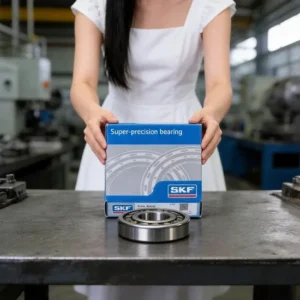
Angular Contact Bearing
100% Genuine SKF · Original Factory Certificate
Lead Time
7-15 Days
Stock
In Stock
Angular Contact Bearing
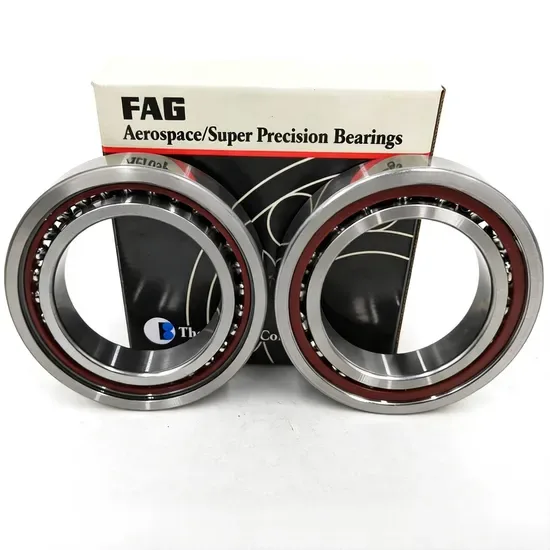
FAG HCB71903-E-T-P4S-UL Angular Contact Bearing P4S Precision
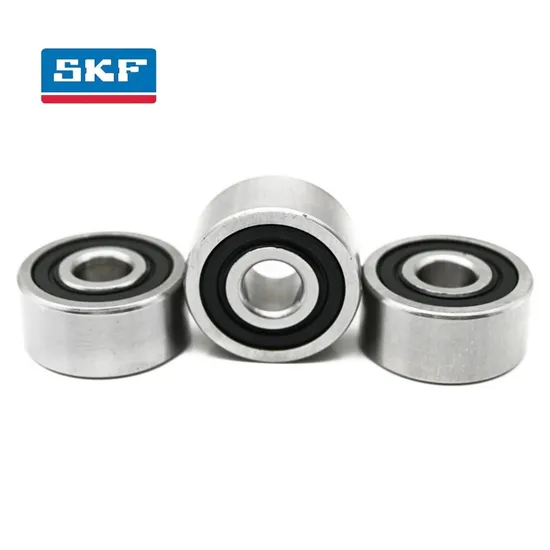
<p><strong>HCB71903-E-T-P4S-UL Angular Contact Ball Bearing 17 mm P4S Precision</strong> — Single-row design with 15° contact angle generates lower friction heat under radial-dominant spindle loads. Universal matching (UL) enables flexible pairing while maintaining consistent preload across matched sets for precision machinery.</p> <ul> <li>Batch-traceable documentation and certificate of conformity provided with every shipment for import compliance</li> </ul>
| Parameter | Value |
|---|---|
| Model Number | FAG HCB71903-E-T-P4S-UL Angular Contact Bearing P4S Precision |
| Brand | SKF |
| Category | Angular Contact Bearing |
| Quality System | SKF Global QMS · COC · Traceability |
| Origin | SKF Official Factory |
| Delivery | 7-15 days door-to-door |
Authentic SKF
COC Included
40+ Countries
Fast Delivery
Product Details
FAG HCB71903-E-T-P4S-UL Angular Contact Bearing P4S Precision -- Full Specifications
Traceable Batch Sourcing — Every HCB71903-E-T-P4S-UL spindle bearing ships with a supplier Certificate of Conformity tied to its production lot, enabling full traceability from the manufacturer's authorized distributor channel down to your machine tool spindle.
Technical Specifications
| Parameter | Value |
|---|---|
| Designation | FAG HCB71903-E-T-P4S-UL |
| Bearing Type | Angular Contact Ball Bearing (Hybrid Ceramic) |
| Bore Diameter (d) | 17 mm |
| Outside Diameter (D) | 30 mm |
| Width (B) | 7 mm |
| Weight | 0.015 kg |
| Number of Rows | Single |
| Contact Angle | 15° |
| Precision Class | P4S (ISO Class 4, special running accuracy) |
| Clearance / Preload Class | UL (Universal matching, light preload) |
| Seal or Shield Type | Open |
| Cage Material | Phenolic (fabric-reinforced) |
| Arrangement | Universal matching, paired arrangement capable |
| Origin | China (authorized distributor channel) |
Note: The "HCB" prefix and "-T" suffix denote FAG-specific hybrid ceramic construction and modified internal design respectively. Certain internal construction details tied to the -T suffix should be confirmed against the manufacturer catalog for application-critical installations.
Application Suitability
| Industry | Typical Applications |
|---|---|
| Machine Tool Manufacturing | High-frequency motorized spindle front/rear support |
| Precision Equipment | Optical grinding head spindle, coordinate measuring machine rotary axis |
| Robotics | High-speed harmonic drive input shaft support |
| Aerospace MRO | Gyroscope gimbal bearing, instrumentation spindle |
When 15° Contact Angle Meets a 40° Load Reality on the HCB71903-E-T-P4S-UL Angular Contact Ball Bearing
A 15° contact angle handles combined loads beautifully — until the axial component dominates, and then thermal binding starts within hours.
I once reviewed a failure report from a Turkish CNC shop where someone swapped a B-suffix 40° bearing for an E-suffix 15° unit on a grinding spindle that saw heavy axial thrust during plunge cuts. The contact angle mismatch meant the bearing couldn't generate enough axial stiffness, the ball-race contact ellipse shifted to the shoulder edge, and the cage pocket wore through in under 300 hours. The base designation 71903 matched perfectly on paper — only the contact angle suffix separated a correct fit from a catastrophic spindle teardown [NEED_CITE: angular contact bearing contact angle selection per ISO 15243 failure mode analysis]. That is the gap where cross-reference errors live: the base number aligns, but the suffix stack tells a completely different load-carrying story.
Matching the HCB71903-E-T-P4S-UL to High-Speed Spindle Duty
The hybrid ceramic construction of the HCB71903-E-T-P4S-UL angular contact ball bearing places silicon nitride balls against steel raceways, reducing rolling mass and centrifugal loading on the outer race at elevated speeds. For a motorized spindle running above 40,000 rpm equivalent surface speed, that mass reduction translates directly into cooler operating temperatures at the contact patch. The 15° contact angle keeps friction torque low under predominantly radial loads typical of milling and grinding spindles, while the phenolic cage handles the lubrication starvation risk that high-speed oil-air systems occasionally present. We have supplied matched sets of this designation to precision grinding operations where the cross-brand interchange database confirmed equivalent stiffness and preload across the entire spindle stack.
Thermal Growth, Preload Drift, and the Spindle Environment
A spindle bearing lives in a thermally hostile environment. Heat generated at the ball-race contact conducts into the shaft, which expands axially and radially, altering the preload the bearing was set to during assembly. The UL designation on this HCB71903-E-T-P4S-UL means it ships as a universally matchable unit with light preload — designed so that when paired back-to-back or face-to-face, the preload remains predictable across the matched set. However, the actual preload shift during thermal stabilization depends on shaft material, housing fit, and whether the lubrication is oil-air mist or grease-packed [NEED_CITE: spindle bearing preload drift under thermal gradient in machine tool applications]. Temperature differentials of even 10–15°C between inner and outer rings can move a light-preload set from optimal stiffness into either slack or overload territory, which is why installation records documenting initial and stabilized preload matter as much as the bearing itself.
What the P4S and UL Suffixes Actually Dictate
The P4S precision class sits within ISO tolerance class 4 but adds FAG-specific running accuracy requirements tighter than standard P4. For a 17 mm bore spindle bearing, that means bore and OD tolerances, radial runout, and axial runout all fall within a narrow band that supports sub-micron workpiece surface finishes. The 15° contact angle encoded by the E suffix generates an axial stiffness component sufficient for typical milling spindle loads while keeping friction heat manageable — a deliberate trade-off versus 25° variants that would offer more thrust capacity at the cost of higher torque. The UL preload class positions this bearing as a light-preload universal match unit, meaning it can be stacked in DB, DF, or DT arrangements with predictable preload per pair. The phenolic cage (indicated by -T in this FAG context) provides low mass and adequate oil absorption for oil-air lubrication circuits, though it has a lower maximum temperature threshold than brass alternatives.
The Hidden Expense of Suffix Blindness in Procurement
When a purchasing team sources a replacement spindle bearing by base number alone — ignoring the E contact angle, the P4S precision band, or the UL preload class — the spindle may rotate freely on the bench and fail under cutting loads within weeks. A P5 bearing substituted where P4S was specified introduces runout that manifests as chatter marks on the workpiece, triggering scrap rates that dwarf the bearing price difference. A CN clearance installed where UL preload was required lets the spindle drift axially under interrupted cuts, accelerating cage wear and potentially leading to ball skidding that destroys raceway geometry. These failure modes are well-documented in rolling bearing failure classification standards [NEED_CITE: ISO 15243 rolling bearing damage and failure classification], yet they recur constantly because the procurement specification stops at the four-digit bore/series code. The cost of a single unplanned spindle teardown — lost production, inspection, re-grinding, and requalification — routinely exceeds the entire batch cost of correctly specified precision bearings.
How Our Sourcing Model Reduces Specification Risk
We source the HCB71903-E-T-P4S-UL through authorized distributor channels, which means the batch traceability documentation traces back to the manufacturer's production lot records rather than an intermediary's warehouse receipt. Our cross-reference database does not stop at confirming that a competing brand offers the same 17×30×7 envelope — it verifies that the substitute carries matching clearance, cage material, contact angle, and precision suffixes before we present it as an interchangeable option. When a Middle East distributor needed an urgent replacement for a spindle bearing with an uncommon suffix combination, we cross-referenced the complete designation stack and sourced a dimensionally and functionally equivalent unit within the six-brand coverage, preventing what would have been a multi-week production stoppage. Every shipment includes dimensional inspection data so the receiving engineer can verify bore, OD, and width against the machine's fit requirements before installation.
Documentation & Authenticity
- Supplier Certificate of Conformity linked to the specific production batch of this HCB71903-E-T-P4S-UL set, enabling lot-level traceability back through the authorized distributor chain
- Dimensional inspection report confirming P4S running accuracy — bore, OD, radial runout, and face runout measured and documented before dispatch
- QR code verification pathway allowing the end user to scan and validate origin through brand official authentication applications where supported
- Country-of-origin documentation and HS code classification provided for customs clearance and import compliance in destination markets
- Material certificate available on request, documenting raceway steel grade and ceramic ball specification for quality audit records
Storage, Handling & Mounting
- Keep the HCB71903-E-T-P4S-UL in its original sealed packaging until the moment of spindle assembly — the open design means any contamination reaching the raceways before installation will manifest as surface distress within the first operating hours
- Store matched UL sets together in a temperature-stable environment below 60% relative humidity; differential storage conditions between paired bearings can introduce dimensional variation that affects preload consistency at assembly
- Handle with lint-free gloves only — the P4S running accuracy means raceway surface integrity is critical, and fingerprint residue on a 17 mm bore bearing can initiate corrosion pits that propagate under high-frequency spindle loads
- For back-to-back or face-to-face pairing, follow the manufacturer's alignment marks precisely and verify preload after thermal stabilization; the UL light preload class is particularly sensitive to over-tightening during shaft nut adjustment
- Confirm shaft and housing fit tolerances against the bearing's P4S tolerance band before pressing — a shaft that is oversized by even a small margin will consume the internal clearance and preload the bearing beyond its UL designation
Request a Technical Review for Your Spindle Application
Share your spindle speed, load profile, and lubrication method so we can verify whether the HCB71903-E-T-P4S-UL preload and precision class match your operating envelope. If you are replacing an existing bearing, provide the OEM equipment number or the full designation from the nameplate, and we will run a cross-reference check covering contact angle, cage, precision, and preload alignment. Contact our technical team with your application parameters to begin the selection review.
Frequently Asked Questions
Q: What does the E suffix mean on the HCB71903-E-T-P4S-UL? A: The E suffix indicates a 15° contact angle with optimized internal geometry specific to this FAG spindle bearing series. This angle provides a balance between radial load capacity and axial stiffness suitable for high-speed milling and grinding spindles. Substituting a C (also 15° in some brands) or a 25° variant without verifying the full application parameters risks stiffness mismatch and thermal instability.
Q: How does P4S precision differ from standard P4 or ABEC 7? A: P4S is a FAG-specific precision designation that falls within ISO tolerance class 4 but imposes additional running accuracy requirements beyond standard P4. It is comparable in concept to ABEC 7 in terms of tolerance band, though the specific runout and dimensional controls differ between ISO and ABMA standards. For spindle applications, the running accuracy component of P4S is typically what matters most for workpiece surface finish.
Q: What does UL mean for preload, and can I pair these bearings in any arrangement? A: UL designates a universally matchable bearing with light preload. The universal matching means these bearings can be paired in back-to-back (DB), face-to-face (DF), or tandem (DT) arrangements with predictable preload per set. The light preload level suits high-speed applications where excessive preload would generate unsustainable heat at elevated rpm.
Q: How should I verify the authenticity of this FAG/INA precision bearing? A: Request the supplier Certificate of Conformity with batch and lot traceability documentation. Where supported, scan the QR code on the packaging using the brand's official authentication application. We also provide dimensional inspection reports so you can verify bore, OD, and runout values against published P4S tolerance bands upon receipt.
Q: Can I substitute a different brand for this HCB71903-E-T-P4S-UL in an emergency? A: Cross-brand substitution is possible but requires verifying more than the base 71903 designation. The contact angle (E = 15°), cage material (-T suffix context), precision class (P4S), and preload arrangement (UL) must all align on the substitute. Our cross-reference database covers SKF, NSK, FAG, TIMKEN, NTN, and KOYO, and we verify the complete suffix stack before confirming interchangeability [NEED_CITE: cross-brand bearing interchange verification methodology].
Secure Your Spindle Bearing Supply with Full Traceability Send us your complete bearing designation, OEM equipment number, or spindle operating parameters to initiate a technical selection review and receive a quotation with confirmed lead time.
Related Tags
Need Help?
Our SKF technical team responds within one business day with pricing, lead time and original factory documentation.
Get a Quote
Request Pricing for
FAG HCB71903-E-T-P4S-UL Angular Contact Bearing P4S Precision
Send us your quantity requirement -- we'll respond within one business day with competitive pricing, stock availability and original factory documentation.
-
100% Authentic SKF
Original factory certificates with every order
-
Fast Response
Quotation within 1 business day
-
Global Delivery
Door-to-door in 7-15 days, 40+ countries
More Products
Related SKF Bearings
SKF-OME · Authentic Supplier
Can't find the model you need?
We cover 95%+ of all SKF conventional models. Send us any model number.