
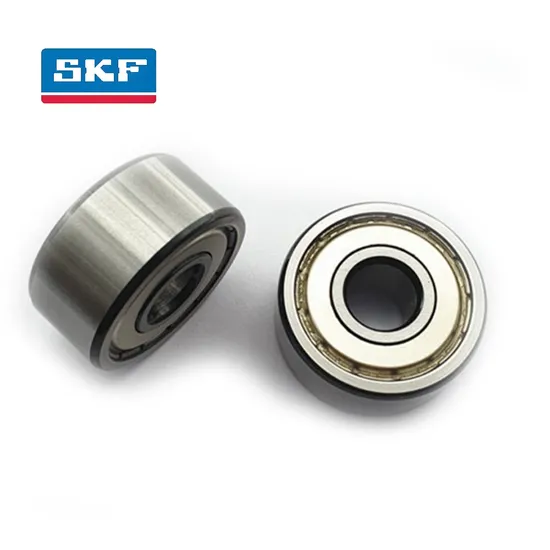
Angular Contact Bearing

100% Genuine SKF · Original Factory Certificate
Lead Time
7-15 Days
Stock
In Stock
Angular Contact Bearing
FAG HCB7006-C-T-P4S Angular Contact Bearing P4S Precision Wholesale
<p><strong>FAG HCB7006-C-T-P4S Angular Contact Ball Bearing 30 mm</strong> — Hybrid ceramic (Si₃N₄) balls with phenolic resin cage deliver low-friction, high-speed stability for robotics joints and automation spindles. The <strong>15° contact angle</strong> and P4S precision class ensure minimal runout under radial-dominant loads. Sourced through authorized Schaeffler channels with full batch traceability and origin documentation for import compliance.</p>
| Parameter | Value |
|---|---|
| Model Number | FAG HCB7006-C-T-P4S Angular Contact Bearing P4S Precision Wholesale |
| Brand | SKF |
| Category | Angular Contact Bearing |
| Quality System | SKF Global QMS · COC · Traceability |
| Origin | SKF Official Factory |
| Delivery | 7-15 days door-to-door |
Authentic SKF
COC Included
40+ Countries
Fast Delivery
Product Details
FAG HCB7006-C-T-P4S Angular Contact Bearing P4S Precision Wholesale -- Full Specifications
Sourced via Authorized Channels — Every FAG HCB7006-C-T-P4S we supply ships with a Certificate of Conformity tied to a verifiable production batch, backed by distributor-level traceability documentation rather than a generic trading company receipt.
Technical Specifications
| Parameter | Value |
|---|---|
| Designation | FAG HCB7006-C-T-P4S |
| Bearing Type | Angular Contact Ball Bearing |
| Bore Diameter (d) | 30 mm |
| Outside Diameter (D) | 55 mm |
| Width (B) | 13 mm |
| Number of Rows | Single Row |
| Contact Angle | 15° |
| Cage Material | Solid phenolic resin, outer ring centered |
| Rolling Element | Hybrid ceramic (Si₃N₄) balls |
| Precision Class | P4S |
| Seal or Shield Type | Open |
| Bore Type | Cylindrical |
| Weight | 0.100 kg |
| Origin | China |
| Standards | ISO 492, ISO 15 |
Note: The "S" suffix appended to P4 in this designation is not found in the standard SKF/FAG published speed-precision matrix; its exact tolerance band should be confirmed against the current Schaeffler catalog before finalizing spindle tolerances.
Application Suitability
| Industry | Typical Applications |
|---|---|
| Industrial machinery | High-speed spindle nose bearing in CNC machining centers |
| Robotics & automation | Rotary joint axis bearing in collaborative robot arms |
| Precision equipment | Precision grinding wheel headstock support |
What Happens When a 15° Ceramic Hybrid Gets Swapped for a Standard Steel 7006
The base number matched, but everything after the dash was wrong — and the spindle paid for it within three weeks.
On a factory floor in Lagos, I watched a CNC spindle overheat and destroy a batch of aluminum aerospace brackets. The maintenance team had replaced a failed bearing with a standard 7006 steel-ball, P5 tolerance unit because the bore and outside diameter were identical. What they missed was that the original position called for a hybrid ceramic ball set, a phenolic cage rated for high-speed operation, and a 15° contact angle optimized for predominantly radial loads at elevated rpm. The steel balls generated excess friction heat, the polyamide cage deformed under centrifugal load, and the wrong contact angle shifted the load zone. The workpiece surface finish degraded progressively until the spindle was shut down for a full rebuild. [NEED_CITE: spindle bearing replacement errors causing thermal failure in high-speed machining]
That is precisely why the FAG HCB7006-C-T-P4S angular contact ball bearing exists as a complete package — not just a bore size.
How This Bearing Fits Robotics Joint and Spindle Duty Cycles
Robotics joints and machine tool spindles share a common demand: sustained rotational accuracy under varying thermal conditions. The FAG HCB7006-C-T-P4S angular contact ball bearing meets that demand through its silicon nitride ceramic balls, which are roughly 40% lighter than steel equivalents. Lower ball mass means reduced centrifugal force at speed, which translates to less contact stress on the raceways and lower operating temperature. When we supply this bearing to automation integrators, we cross-check the contact angle and cage material against the OEM specification — not just the base number — because a 15° angle is chosen specifically for applications where radial loads dominate and axial thrust is minimal.
Thermal Growth, Speed Envelopes, and Why Open Bearings Shift Responsibility
In a spindle or robot joint running at sustained high rpm, internal temperature rise directly affects the operating clearance. A bearing installed with standard CN clearance in a high-speed application can lose all internal clearance once thermal expansion closes the gap between balls and raceways. The open design of the HCB7006-C-T-P4S means the end user controls lubrication type, fill quantity, and replenishment intervals — a deliberate choice for applications where oil-air or oil-mist systems are already engineered into the spindle housing. The trade-off is that contamination exclusion becomes the responsibility of the housing seal design, not the bearing itself. [NEED_CITE: open bearing lubrication responsibility in high-speed spindle housing design]
Installation in precision spindles typically involves controlled interference fits on both the shaft and housing, with temperature differentials managed through selective heating or cooling rather than forceful pressing that could damage the ceramic ball surface.
Decoding the Suffixes That Define Performance
The HC prefix confirms hybrid ceramic construction: silicon nitride (Si₃N₄) balls running on hardened steel raceways. Ceramic balls resist electrical erosion, generate less friction heat, and maintain hardness at temperatures where steel balls begin to lose surface integrity.
The C suffix denotes a 15° contact angle. This is the shallowest standard angle in the angular contact family, chosen when the application imposes primarily radial loads with light axial components. A 15° angle produces lower friction torque than 25° or 40° alternatives, which matters in spindles where every watt of heat generated inside the bearing must be extracted by the cooling system.
The T suffix identifies a solid phenolic resin cage, centered on the outer ring. Phenolic cages are lightweight, handle sustained high-speed operation well, and tolerate the oil-mist or grease lubrication typical of spindle environments. They are not suited to applications where temperatures exceed their thermal limit or where the lubricant is incompatible with phenolic materials.
The P4S precision class indicates running accuracy tighter than standard P4. In practice, this means bore and outside diameter tolerances, radial runout, and axial runout all fall within a band that supports minimal spindle nose displacement — a requirement for finishing passes on aerospace and medical device components where surface finish specifications are measured in single-digit micrometers.
The Hidden Cost of Ignoring What Comes After the Dash
A purchasing decision based on base number alone — matching bore, OD, and width — while overlooking contact angle, cage material, and precision class leads to failures that ISO 15243 classifies under multiple damage modes: thermal discoloration from excess friction, cage wear from centrifugal overload, and premature fatigue from incorrect load zone distribution. [NEED_CITE: ISO 15243 rolling bearing damage classification modes]
In a robotics joint, a mismatched bearing may not fail catastrophically. Instead, positioning accuracy drifts over weeks of operation, cycle times are extended to compensate for vibration, and the robot is eventually pulled from the line for an unplanned teardown. In a spindle, the consequences arrive faster: thermal growth closes internal clearance, the bearing seizes, and the spindle cartridge — a component costing many times the price of the bearing itself — requires replacement or reconditioning. The cost of the correct bearing is negligible compared to the cost of the downtime it prevents.
Why Procurement Engineers Source This Bearing Through Our Channel
We do not hold a single-brand franchise. Instead, we source the FAG HCB7006-C-T-P4S angular contact ball bearing through authorized distributor channels where each unit carries a batch number traceable to the manufacturer's production facilities. This matters because counterfeit hybrid ceramic bearings have appeared in the market with steel balls coated to mimic ceramic surfaces — a deception that basic visual inspection cannot catch but that QR code verification through Schaeffler's official app can flag immediately.
Our cross-reference database aligns clearance, cage type, and precision suffix simultaneously, not just the base designation. When a maintenance engineer provides an OEM equipment number, we verify whether the original specification called for a phenolic or polyamide cage, whether C3 clearance was specified for thermal expansion, and whether P4S was the original precision class or a field upgrade. We supply country-of-origin documentation and HS code data for import clearance, because customs delays at the port of entry can stall a production line just as effectively as a bearing failure on the factory floor.
Documentation & Authenticity
- Supplier Certificate of Conformity tied to the specific production batch of each FAG HCB7006-C-T-P4S unit shipped
- QR code verification pathway via the FAG/Schaeffler official app, confirming hybrid ceramic ball authenticity and factory origin
- Third-party dimensional inspection report confirming bore, OD, and runout values before dispatch, with results referenced to ISO 492 P4 tolerances
- Country-of-origin certificate and HS code documentation for customs and import compliance in destination markets
- Material certificates for raceway steel grade and ceramic ball certification, available on request for critical spindle applications
Storage, Handling & Mounting
- Keep the HCB7006-C-T-P4S in its original sealed packaging until the moment of installation; premature opening exposes the phenolic cage to ambient humidity that can affect dimensional stability
- Store in a temperature-stable environment away from direct UV exposure, as phenolic resin cages are sensitive to long-term ultraviolet degradation
- Handle ceramic hybrid bearings with clean lint-free gloves; silicon nitride balls are extremely hard and can embed contaminants into the steel raceway if foreign particles are present during mounting
- Mount using controlled interference fit methods — induction heating of the inner ring or controlled cooling of the housing — never forceful hammering that could microchip the ceramic ball surfaces
- For open-type bearings in spindle applications, confirm that the housing seal design provides adequate contamination exclusion, as the bearing itself carries no integral seals
- Apply the specified lubricant type and quantity immediately after mounting; the phenolic cage material requires compatibility verification with the chosen grease or oil before first run
Ready to Verify Fit and Availability?
Share your spindle OEM equipment number or application parameters — load profile, operating speed range, and lubrication system type — so we can confirm whether the FAG HCB7006-C-T-P4S angular contact ball bearing matches your original specification or whether a cross-reference alternative with identical clearance, cage, and precision is available from stock.
Frequently Asked Questions
Q: How can I verify that the ceramic balls in an HCB7006-C-T-P4S are genuine silicon nitride and not coated steel? A: Schaeffler provides a QR code on authentic FAG hybrid bearing packaging that links to batch verification through their official app. We supply this code with every unit and can guide your receiving inspection team through the verification process before the bearing leaves your stores.
Q: Why must contact angle, cage material, and precision suffix all match during cross-referencing — not just the base number? A: The base number defines only the bore, OD, and width envelope. A 7006 bearing with a 40° contact angle generates significantly more friction heat than the same bearing at 15° under radial-dominant loads. A polyamide cage has a different speed and temperature limit than a phenolic cage. Mismatch any of these and the bearing may fit the housing but fail the application.
Q: What does the P4S precision class mean compared to standard P4 or ABEC 7? A: P4S indicates a special precision band that is tighter than standard P4 (equivalent to ABEC 7) in specific tolerance dimensions. The exact tolerance values for P4S are published in Schaeffler's super-precision bearing catalog and should be referenced when setting shaft and housing machining tolerances for your spindle design.
Q: Is a phenolic resin cage suitable for grease-lubricated robotics joints, or is oil-mist required? A: Phenolic cages are compatible with both grease and oil-mist lubrication. The critical factor is that the chosen grease must be chemically compatible with phenolic resin and applied in the correct quantity. Over-greasing a phenolic cage bearing generates churning heat that negates the friction advantage of the ceramic balls.
Q: Can I substitute a standard all-steel 7006-C-T-P4S if the hybrid ceramic version is unavailable? A: The steel variant will fit the same envelope and share the same contact angle and cage type, but its limiting speed will be lower and its friction heat generation higher under identical operating conditions. Whether this substitution is acceptable depends on your actual operating speed relative to the steel variant's speed limit and your spindle cooling capacity.
Confirm Specification and Request Documentation Send your OEM equipment number, application speed range, and target delivery port. We will return a matched specification sheet with batch availability, lead time, and the full documentation package required for your import process.
Related Tags
Need Help?
Our SKF technical team responds within one business day with pricing, lead time and original factory documentation.
Get a Quote
Request Pricing for
FAG HCB7006-C-T-P4S Angular Contact Bearing P4S Precision Wholesale
Send us your quantity requirement -- we'll respond within one business day with competitive pricing, stock availability and original factory documentation.
-
100% Authentic SKF
Original factory certificates with every order
-
Fast Response
Quotation within 1 business day
-
Global Delivery
Door-to-door in 7-15 days, 40+ countries
More Products
Related SKF Bearings

SKF-OME · Authentic Supplier
Can't find the model you need?
We cover 95%+ of all SKF conventional models. Send us any model number.