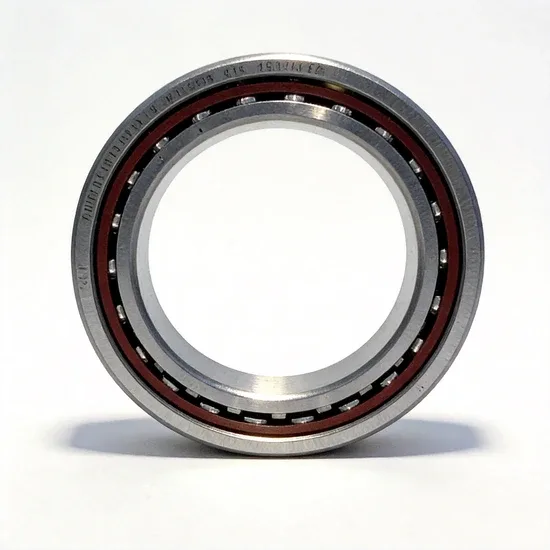
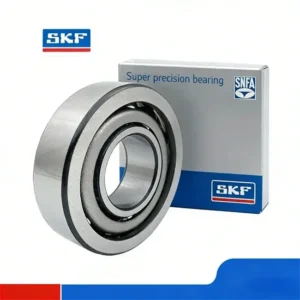
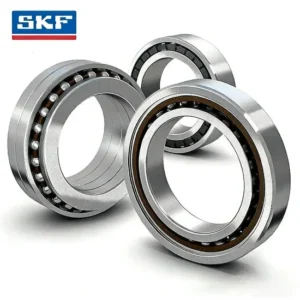
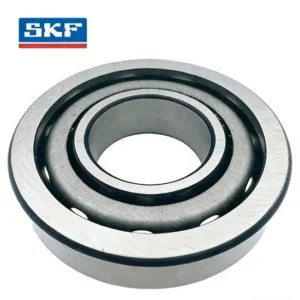
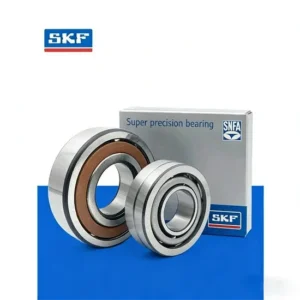
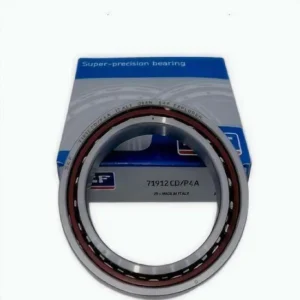
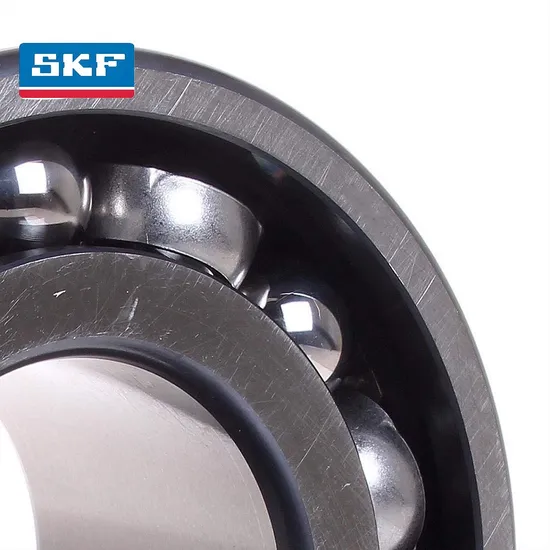
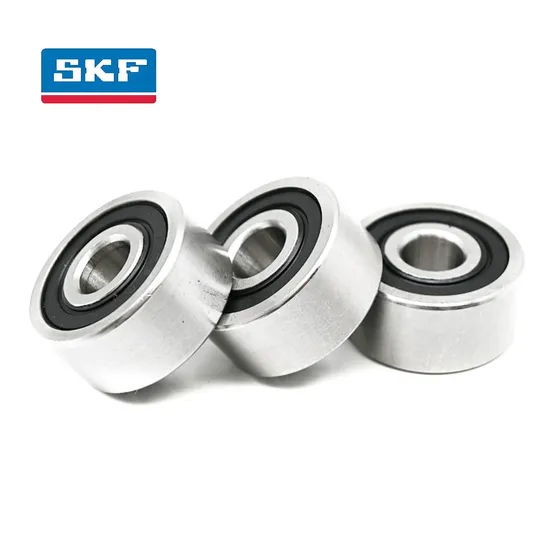
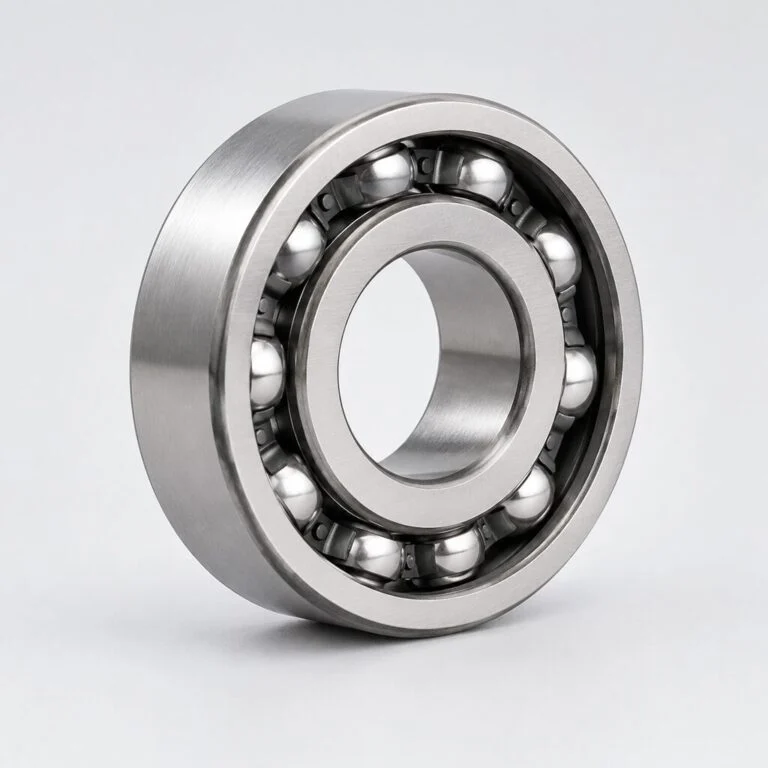
Listed data for this SKF designation; confirm the execution and dimensions against your drawing or application before ordering.
Authorized Channel Traceability — Every SKF 7010 CD/P4ADGC 2RS we ship carries lot-level documentation tracing back through SKF's authorized distribution network, so procurement teams can close the authenticity loop before the bearing reaches the spindle.
Technical Specifications
| Parameter | Value |
| Designation | SKF 7010 CD/P4ADGC 2RS |
| Bearing Type | Angular Contact Ball Bearing |
| Bore Diameter (d) | 50 mm |
| Outside Diameter (D) | 80 mm |
| Width (B) | 16 mm |
| Precision Class | P4 (ISO 492 Class 4) |
| Contact Angle | 15° (CD internal design) |
| Seal or Shield Type | Contact seal on both sides (2RS) |
| Number of Rows | Single Row |
| Arrangement | Paired — Back-to-Back (DB), Heavy Preload (GC) |
| Bore Type | Cylindrical |
| Origin | China |
| Weight | 0.100 kg |
Note: Suffixes A, D, G, and C within the P4ADGC string contain context-dependent designations; full decoding should be confirmed against the current SKF precision bearing catalog before final specification sign-off.
Application Suitability
| Industry | Typical Applications |
| Machine tool manufacturing | High-speed CNC spindle front and rear journal positions |
| Precision equipment | Rotary table indexing bearings, grinding wheel spindles |
| Industrial pumps | High-speed pump shaft support where axial thrust is present |
| Robotics | Joint actuators requiring low runout under combined loads |
Why a Suffix String Can Shut Down a CNC Spindle
Cross-reference errors remain one of the costliest procurement mistakes in precision angular contact bearings. A buyer matches the base number — say, 7010 — but the replacement arrives with standard P0 tolerance and CN clearance instead of the P4 precision and matched preload the spindle demands. The result is thermal runaway within hours, chatter marks on every workpiece, and a week of lost production before the root cause surfaces.
The SKF 7010 CD/P4ADGC 2RS angular contact ball bearing eliminates that guessing game by encoding precision class, contact angle, preload grouping, and seal configuration directly into the designation. Each suffix element governs a specific performance boundary. When even one is wrong, the bearing may fit the housing but fail the application.
Procurement engineers sourcing replacements for OEM spindle assemblies know that the base designation is only the starting point. The suffix string is where thermal stability, rigidity, and contamination protection are decided — and where most supply chain substitutions quietly go wrong.

Matching Spindle Demands to a Paired Precision Set
A CNC spindle running at sustained high rpm needs two things from its angular contact bearings: minimal runout to preserve surface finish, and enough axial rigidity to resist cutting forces without deflection. The SKF 7010 CD/P4ADGC 2RS delivers both through its P4 tolerance class and back-to-back paired arrangement with heavy preload. The 15° contact angle keeps friction heat low under predominantly radial loads, which matters when spindle temperatures must stay within a few degrees to hold dimensional accuracy on the workpiece.
We routinely see maintenance teams pull a failed bearing from a spindle, read only the base number, and reorder without checking the preload class. That single omission can introduce chatter, accelerate cage wear, and shorten the entire spindle rebuild cycle. Our cross-reference process checks clearance, cage material, contact angle, and preload grouping together — not just the numeric prefix — so the replacement set behaves identically to the OEM installation.
Thermal Growth, Contamination, and the Sealed Precision Bearing
High-speed spindles generate heat at the contact ellipse, and that heat travels outward through the inner ring into the shaft. If the bearing's internal clearance was not specified for the operating temperature range, thermal expansion closes the gap and the bearing runs under unintended preload — accelerating wear and sometimes causing seizure. The heavy preload grouping (GC) in this designation is engineered for applications where rigidity must be maintained despite thermal growth, but only when the spindle's thermal profile matches the preload selection.
The 2RS contact seals on both sides add a layer of contamination defense that open bearings simply cannot provide. In machine environments where coolant mist, fine swarf, or airborne particulate are constant threats, these seals retain the factory grease charge and exclude debris without requiring an external sealing system. The trade-off is slightly higher friction torque compared to shielded or open configurations, but for many spindle designs the contamination protection outweighs the speed penalty.
Inside the Suffix String — What Each Element Controls
The P4 precision class meets ISO 492 Class 4 requirements, delivering tighter bore, outside diameter, and running accuracy than P5 or P6 grades. In a spindle application, this translates to lower radial and axial runout at the tool tip, which directly affects surface finish and tool life.
The CD internal design specifies a 15° contact angle. Lower contact angles produce less friction heat under radial-dominant loads, making them the preferred choice for high-speed spindle front bearings where speed capability and thermal stability take priority over maximum axial stiffness.
Back-to-back pairing (DB) provides high moment rigidity, resisting the tilting forces that cutting loads impose on a spindle nose. Heavy preload (GC) eliminates internal clearance entirely, ensuring the bearing set acts as a single rigid unit from the moment the spindle starts — critical for eliminating chatter during interrupted cuts.
The 2RS contact seals complete the picture by retaining lubricant and blocking contaminant ingress on both sides, reducing the dependency on external spindle sealing systems.
What a Mismatched Replacement Costs Beyond the Bearing
Installing an open bearing where a sealed one was specified exposes the grease charge to coolant and particulate, triggering lubricant degradation that ISO 15243 classifies under surface distress and smearing. Running a light preload set in a heavy preload position allows micro-movement between rolling elements and raceways, accelerating false brinelling. Each scenario ends the same way: unplanned downtime, a second teardown, and warranty questions that no supplier wants to answer.
These failures rarely show up on day one. They surface weeks into production, when a spindle that was running fine begins throwing dimensional drift or surface finish alarms. By then, the cost has compounded far beyond the bearing's invoice price — scrap parts, missed shipments, and emergency rebuild labor all pile on.
How We Support Precision Bearing Procurement
Our sourcing model operates through authorized distributor channels rather than single-brand distributorship, which means every SKF 7010 CD/P4ADGC 2RS we supply carries traceable documentation back to the manufacturer's production facilities. Procurement engineers receive batch and lot traceability with each shipment, not generic packing slips.
When a cross-reference is requested — whether from FAG, NSK, or NTN — we match on clearance class, cage type, contact angle, precision grade, and preload grouping simultaneously. A base number swap without suffix alignment is not a cross-reference; it is a gamble. Our interchange charts flag every suffix-level mismatch before a quotation is issued.
Country-of-origin documentation is prepared with each order for import compliance, and QR code verification pathways through SKF's official applications allow receiving teams to confirm authenticity before the bearing leaves the storeroom.
Documentation & Authenticity
- Supplier Certificate of Conformity (COC) referencing the specific batch and lot number of the SKF 7010 CD/P4ADGC 2RS shipped
- QR code verification pathway enabling receiving inspectors to scan and confirm authenticity via SKF's official mobile application
- Country-of-origin certificate prepared per shipment to support import customs documentation and buyer verification requirements
- Dimensional inspection report confirming P4 running accuracy and bore/outside diameter tolerances before dispatch
- Material certificate documenting steel grade and heat treatment compliance for traceability audits
Storage, Handling & Mounting
- Keep the matched DB pair sealed in original packaging until the moment of mounting; early opening risks contaminating the factory-applied grease charge protected by the 2RS contact seals
- Store in a temperature-stable environment to prevent condensation inside the packaging, which could compromise the P4 precision surfaces before installation
- Handle with clean, lint-free gloves to avoid transferring skin oils onto the sealed exterior, which can attract particulate in the machine environment
- Mount using controlled induction heating for the inner ring only; excessive heat risks degrading the 2RS seal material and the factory grease fill
- Verify paired orientation markings on the outer ring before pressing into the spindle housing — incorrect clocking of the back-to-back pair reverses the load distribution and eliminates the intended heavy preload
Request a Precision Bearing Quotation
Share your spindle's operating speed range, typical cutting load profile, and OEM equipment number so we can confirm whether the SKF 7010 CD/P4ADGC 2RS angular contact ball bearing matches your application or whether an alternative preload class or seal configuration would serve better. We will return a quotation with confirmed lead time, MOQ, and a full documentation package preview. If you need a cross-reference checked against an existing competitor part number, include that designation and we will verify suffix-level alignment across clearance, contact angle, cage, and precision grade.
Frequently Asked Questions
Q: How can I verify that the SKF 7010 CD/P4ADGC 2RS I receive is genuine?
A: Each bearing carries a QR code that can be scanned through SKF's official mobile application, linking to batch and lot traceability records in the manufacturer's system. We also supply a Certificate of Conformity with shipment-specific lot references, and third-party pre-shipment inspection can be arranged upon request.
Q: Why does suffix accuracy matter more than the base number when cross-referencing angular contact bearings?
A: The base number defines only the bore, outside diameter, and width. Contact angle, precision class, preload grouping, and seal type — all encoded in the suffix — determine whether the bearing can handle the thermal, rigidity, and contamination demands of the actual application. A mismatch in any suffix element can cause premature failure even when the bearing physically fits.
Q: What is the difference between ISO P4 and P5 precision for angular contact ball bearings?
A: P4 specifies tighter tolerances on bore diameter, outside diameter, and running accuracy than P5. In spindle applications, P4 reduces radial and axial runout at the tool tip, improving surface finish and enabling tighter machining tolerances. The appropriate class depends on the spindle's required precision and speed envelope.
Q: What does the CD suffix mean on this SKF angular contact bearing?
A: CD indicates a 15° contact angle with an optimized internal geometry. The lower contact angle is suited to applications with predominantly radial loads and high rotational speeds, where minimizing friction heat generation is more critical than maximizing axial rigidity.
Q: Can the 2RS seals on this bearing be removed for relubrication?
A: The 2RS contact seals are designed to retain the factory grease fill and exclude contaminants for the bearing's service life in typical spindle applications. Removing them compromises the seal integrity and is not recommended; if the application requires relubrication, an open or shielded configuration should be specified instead.
Secure Your SKF 7010 CD/P4ADGC 2RS with Full Traceability
Send us your application parameters or OEM part number, and we will confirm specification alignment, provide a documentation preview, and quote with confirmed availability.