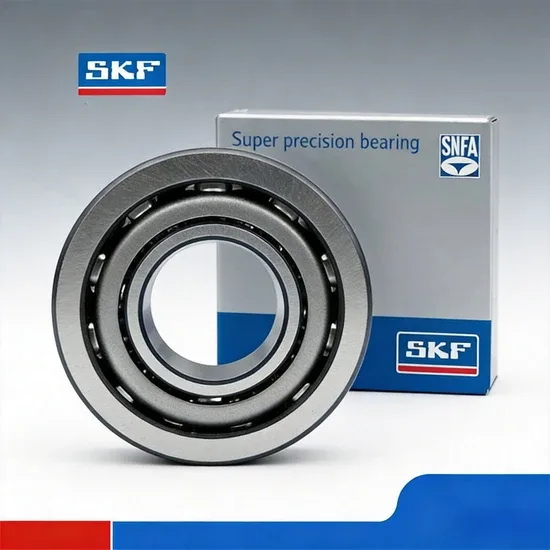
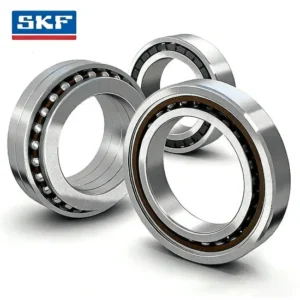
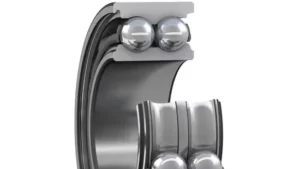
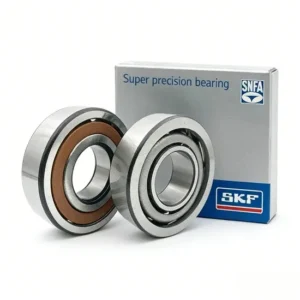
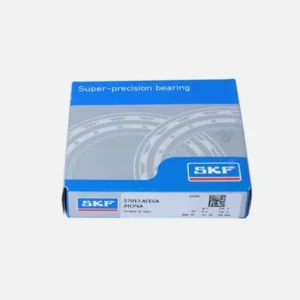
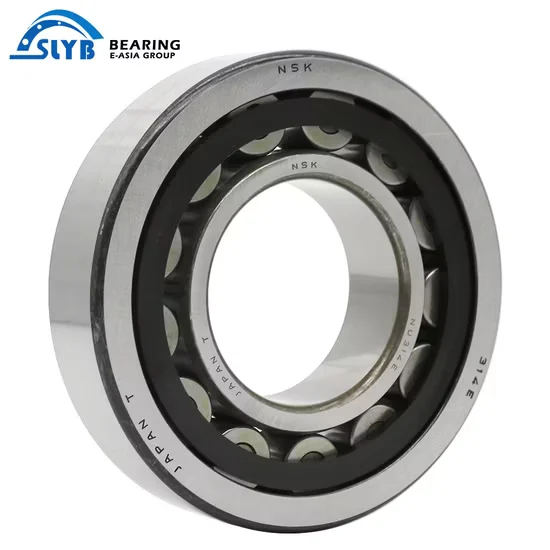
Listed data for this SKF designation; confirm the execution and dimensions against your drawing or application before ordering.
Batch-Traceable Sourcing — Every 7012 ACDGB/HCP4A unit ships with supplier Certificate of Conformity linking lot number to authorized distributor channel records.
Technical Specifications
| Parameter | Value |
| Designation | 7012 ACDGB/HCP4A Angular Contact Ball Bearing |
| Bearing Type | Single Row Angular Contact Ball Bearing |
| Bore Diameter (d) | 60 mm |
| Outside Diameter (D) | 95 mm |
| Width (B) | 18 mm |
| Contact Angle | 25° (ACD suffix) |
| Precision Class | P4 (ISO 492 tolerance class 4) |
| Arrangement | Universal Matching, Moderate Preload (GB suffix) |
| Number of Rows | Single Row |
| Origin | China |
Note: The "H" and "CP4A" segments within the suffix string require confirmation against the manufacturer catalog; the precision designation confirmed from supplier documentation is P4.
Application Suitability
| Industry | Typical Applications |
| Machine Tool Manufacturing | High-speed spindle front/rear bearing positions |
| Energy & Mining | Gearbox high-speed shaft support, crusher drive pinion |
| Precision Industrial Equipment | Robotics joint actuators, precision pump shafts |
What Happens When Buyers Ignore the ACD and GB Suffixes on a 7012 Spindle Bearing
Matching base number 7012 without verifying contact angle and preload class leads to thermal binding within weeks of spindle startup.
I have seen this pattern repeat at trade shows and in post-failure teardowns: a maintenance team replaces a worn angular contact bearing by searching the base designation alone. The replacement arrives with a 15° contact angle where 25° was specified, or with light preload where moderate preload maintained shaft rigidity. The spindle runs hot, vibration climbs, and the cage shows copper smearing in the oil sample long before the next scheduled outage. A 7012 ACDGB/HCP4A angular contact ball bearing supplier who only confirms the bore and outside diameter is leaving critical performance parameters to chance.

How This Bearing Fits High-Speed Spindle and Gearbox Service
The 60 mm bore and 95 mm outside diameter place the 7012 ACDGB/HCP4A angular contact ball bearing squarely in the envelope used by mid-range machining center spindles and industrial gearbox high-speed shafts. The universal matching with moderate preload means two bearings can be mounted back-to-back or face-to-face without custom shimming, which cuts assembly time and reduces inventory complexity for maintenance departments stocking replacements across multiple equipment lines. When a buyer submits OEM equipment numbers rather than just bearing designations, cross-reference verification confirms that contact angle, preload class, and precision grade all align with the original installation — not just the outer dimensions.
Load Spectrum and Thermal Behavior at Speed
Combined radial and axial loads dominate in spindle and gearbox applications, and the 25° contact angle handles axial thrust more effectively than a 15° variant while still supporting the radial component from gear mesh or belt drive forces. At sustained high speeds, friction heat at the ball-raceway contact raises inner ring temperature faster than outer ring temperature, which reduces internal clearance. The moderate preload specified by the GB suffix compensates for this thermal shift, maintaining shaft rigidity without overloading the cage. Oil-air or oil-mist lubrication is typical in these positions; grease-packed arrangements require careful attention to fill volume and relubrication intervals to avoid churning losses.
Decoding the Suffix String for Specification Compliance
The ACD segment confirms a 25° contact angle with optimized internal geometry, giving higher axial capacity than the 15° CD variant commonly used in ultra-high-speed small-diameter spindles. The GB segment indicates universal matching with moderate preload — positioned between GA (light) and GC (heavy) — which suits applications where shaft rigidity matters but excessive preload would accelerate temperature rise. The P4 precision class meets ISO 492 tolerance class 4 requirements for dimensional and running accuracy, keeping radial and axial runout within limits that prevent chatter marks on machined surfaces and vibration signatures in gearbox operation. The single row design allows flexible paired arrangements, and the 60×95×18 mm dimensions fit standard housing and shaft seat tolerances specified in ISO 15 for this size range.
The Downtime Cost of Skipping Suffix Verification
A bearing that matches the base number but carries the wrong precision grade or contact angle does not fail immediately — it degrades gradually. Vibration levels creep upward, surface finish on machined parts drifts out of tolerance, and unplanned downtime arrives during peak production. Under ISO 281 life calculation frameworks, running a P0 grade bearing in a position specified for P4 precision shortens L10 life significantly because uneven load distribution across rolling elements concentrates stress on fewer contact points. Counterfeit units with soft inner rings and cloned markings compound the problem: they pass visual inspection but exhibit raceway spalling within weeks under moderate loads. The financial exposure extends beyond replacement parts to include scrap product, missed delivery penalties, and emergency freight charges.
How We Support Specification-Critical Procurement
Our sourcing model centers on authorized distributor channels with traceable lot documentation, so every 7012 ACDGB/HCP4A angular contact ball bearing ships with verifiable origin records rather than unmarked stock. Cross-reference matching covers contact angle, preload class, and precision grade simultaneously — not just bore and OD — ensuring that substitute brands meet the full suffix requirement. Third-party dimensional inspection reports confirm P4 tolerance compliance before dispatch, and country-of-origin documentation supports import clearance for buyers managing customs requirements across jurisdictions. Application-based selection guidance addresses questions about preload pairing, lubrication compatibility, and shaft-housing fit tolerances that generic catalog listings leave unresolved.
Documentation & Authenticity
- Supplier Certificate of Conformity with batch and lot traceability linked to authorized channel purchase records
- Third-party runout inspection report confirming P4 running accuracy on bore and OD before shipment
- Country-of-origin certificate supporting customs documentation and buyer verification requirements
- QR code verification pathway via official brand applications for authenticity confirmation on receipt
- Material test certificate documenting ring and rolling element steel specification compliance
Storage, Handling & Mounting
- Keep the 7012 ACDGB/HCP4A in original sealed packaging until the moment of mounting to protect the P4-finished raceway surfaces from dust ingress
- Store matched universal-pair sets flat and undisturbed; rotating or stacking heavy items on top can shift preload calibration marks on the outer ring faces
- Use clean lint-free gloves when handling the 60 mm bore and 95 mm OD surfaces; fingerprint moisture initiates corrosion on precision-ground finishes within hours in humid environments
- For back-to-back or face-to-face mounting, align the factory-etched V marks on the outer rings before tightening the shaft nut to maintain the specified moderate preload distribution
- Confirm shaft seat and housing bore tolerances against ISO recommendations before pressing or induction-heating the rings; interference fit errors directly compromise P4 running accuracy
Inquiry and Selection Guidance
Share the application parameters — load magnitude and direction, operating speed range, lubrication method, and ambient temperature — so we can verify that the 25° contact angle and moderate preload class suit your specific duty cycle. If you have the OEM equipment number or the original bearing's full designation from the nameplate, send it for cross-reference confirmation against our interchange database. Request the documentation package including origin certificates and inspection reports to support your procurement compliance requirements. We will confirm batch availability, lead time, and minimum order quantity once the technical match is verified.
Frequently Asked Questions
Q: Why is matching the base number 7012 alone insufficient for cross-referencing?
A: The base number defines bore, outside diameter, and width. Contact angle (25° for ACD), preload class (GB moderate), and precision grade (P4) are carried entirely in the suffix string. A substitute bearing matching only the base number may have 15° contact angle or standard precision, causing thermal binding or runout problems in service.
Q: What is the difference between P4 and P5 precision for spindle applications?
A: P4 (ISO 492 class 4) provides tighter dimensional and running accuracy than P5, reducing radial and axial runout. In machine tool spindles, this translates to better surface finish and lower vibration signatures at high speeds where even minor runout generates chatter marks.
Q: How do GB, GA, and GC preload classes affect paired bearing arrangements?
A: GA provides light preload for high-speed low-load applications, GB provides moderate preload balancing rigidity and temperature rise, and GC provides heavy preload for maximum stiffness under heavy cutting forces. The GB class on this bearing suits general spindle and gearbox duties where axial rigidity is needed without excessive friction heat.
Q: What does the ACD suffix indicate compared to CD?
A: ACD indicates a 25° contact angle with optimized internal design, while CD indicates 15°. The 25° angle delivers higher axial load capacity and greater axial rigidity, making ACD preferable for combined-load applications like gearboxes and heavy-cutting spindles.
Q: How can bearing authenticity be verified after delivery?
A: Authentic units carry traceable lot numbers linked to authorized distributor records. Verification through official brand applications using QR codes or serial number lookup confirms the production batch and distribution path. Dimensional inspection against P4 tolerance limits provides additional confirmation of genuine manufacturing quality.
Confirm Your 7012 Spindle Bearing Specifications
Send your OEM equipment number or full operating parameters for cross-reference verification and a matched documentation package. Contact our technical team through your preferred inquiry channel to start the selection review.