
Lead Time
7-15 Days
Stock
In Stock
Angular Contact Bearing
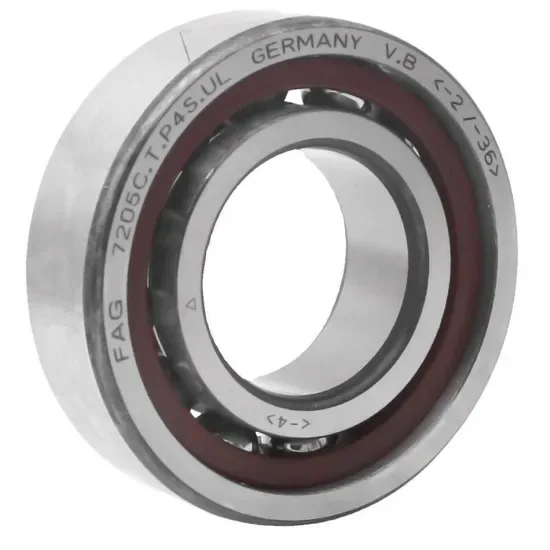
FAG XC7001-C-T-P4S Angular Contact Ball Bearing P4S Precision
<p><strong>FAG XC7001-C-T-P4S Angular Contact Ball Bearing</strong> — single row, 12 mm bore, designed for high-speed spindle use. The <strong>C</strong> suffix denotes 15° contact angle, generating lower friction heat under radial loads, while <strong>P4S</strong> meets ISO tolerance class 4 for minimal runout in precision equipment. Sourced via authorized distributor channels with full batch traceability, COC, and country-of-origin documentation for import compliance. </p>
| Parameter | Value |
|---|---|
| Model Number | FAG XC7001-C-T-P4S Angular Contact Ball Bearing P4S Precision |
| Brand | SKF |
| Category | Angular Contact Bearing |
| Quality System | SKF Global QMS · COC · Traceability |
| Origin | SKF Official Factory |
| Delivery | 7-15 days door-to-door |
Product Details
FAG XC7001-C-T-P4S Angular Contact Ball Bearing P4S Precision -- Full Specifications
Authorized Channel Sourcing — every FAG XC7001-C-T-P4S angular contact ball bearing ships with batch-level traceability back to the manufacturer's distribution network.
Technical Specifications
| Parameter | Value |
|---|---|
| Designation | FAG XC7001-C-T-P4S |
| Bearing Type | Angular Contact Ball Bearing |
| Bore Diameter (d) | 12 mm |
| Outside Diameter (D) | 28 mm |
| Width (B) | 8 mm |
| Contact Angle | 15° |
| Precision Class | P4S (ISO tolerance class 4 with additional specification) |
| Number of Rows | Single Row |
| Weight | 0.100 kg |
| Origin | China |
Note: The suffixes XC and T appear in the designation but are not fully decoded in available references; their exact meaning should be confirmed against the current FAG catalog before final specification lock-in.
Application Suitability
| Industry | Typical Applications |
|---|---|
| Industrial Machinery | High-speed spindle nose assemblies in CNC turning centers |
| Precision Equipment | Rotary table positioning bearings in coordinate measuring machines |
| Robotics | Joint actuator support bearings in articulated robotic arms |
When a 15° Contact Angle Becomes the Wrong Choice at High RPM
Most spindle failures traced to bearing selection start with a contact angle mismatch, not a quality defect.
I once cleared a return shipment from an Italian machine tool builder who specified angular contact bearings by bore size and series number alone. The replacements went in, ran quietly on the bench, then thermally bound the spindle at operating speed. The root cause was a contact angle suited to the wrong load profile. On high-speed spindles where radial loads dominate and axial thrust is moderate, a 15° contact angle generates less frictional heat than a 25° or 40° variant — and that thermal margin is often the difference between stable operation and a scrapped workpiece. The FAG XC7001-C-T-P4S angular contact ball bearing carries the C suffix, confirming that 15° contact angle designed for precisely these conditions. [NEED_CITE: angular contact bearing contact angle selection for high-speed spindle applications]
How This Bearing Fits the Spindle Speed Envelope
Machine tool spindles demand bearings that maintain dimensional stability across thermal gradients while holding tight running accuracy under sustained rotational loads. The P4S precision class on the FAG XC7001-C-T-P4S angular contact ball bearing addresses both requirements — ISO class 4 tolerances keep bore and raceway geometry within bounds that prevent uneven load distribution across the ball set, while the additional specification tied to the S suffix tightens running accuracy parameters that matter most at elevated RPM. When I review cross-brand substitutions for spindle applications, I always verify that the replacement matches not just the base number but the precision suffix, the contact angle, and the cage designation — because missing any one of those three will surface as vibration or thermal drift within the first shift of operation.
Thermal Expansion and the Clearance Question
At sustained speeds above typical spindle ranges, frictional heat at the ball-raceway contact points raises inner ring temperature faster than the housing can dissipate it. That differential expansion reduces internal clearance — and if the bearing was installed with standard CN clearance in an application that needed C3, the clearance can collapse to zero, causing thermal seizure. The 15° contact angle in the C-suffix variant produces lower friction heat than higher-angle designs under predominantly radial loads, which provides a wider thermal margin before clearance exhaustion becomes a risk. Lubrication method compounds the effect: oil-air or oil-mist systems carry heat away from the contact zone more effectively than grease packing, but grease-lubricated spindles rely more heavily on the bearing's inherent thermal efficiency. Installation fit also plays a role — an interference fit on the inner ring further reduces internal clearance, making the starting clearance class a critical selection parameter. [NEED_CITE: thermal expansion effects on bearing internal clearance in high-speed applications]
Why P4S Precision and Cage Design Matter Together
The P4S designation on this bearing indicates ISO tolerance class 4 dimensional accuracy combined with additional running accuracy controls. On a 12 mm bore spindle bearing, even small deviations in raceway roundness translate directly to workpiece surface finish errors at high rotational speeds. The single-row configuration means each bearing in the spindle set must carry its share of combined loads independently, so precision consistency across the set is non-negotiable. The cage material indicated by the T suffix governs how the bearing behaves under speed and vibration: cage design affects ball guidance stability, lubricant distribution, and the maximum safe operating speed. A mismatch between cage type and actual operating speed is one of the most common causes of premature cage fracture in spindle bearings — and cage failure at 18,000 RPM does not end quietly. The lightweight construction at 0.100 kg reflects a compact bearing envelope suited to the small-diameter, high-speed end of spindle design where rotational inertia must be minimized.
The Downtime Cost Nobody Budgets For
Selecting a bearing that matches the base number but misses the precision class, contact angle, or cage specification does not produce an immediate failure — it produces a delayed one. The spindle runs through commissioning, passes acceptance tests, and then begins showing thermal drift or surface finish degradation weeks later. By that point the machine is in production, and pulling it offline for a bearing swap means unplanned downtime, scrapped parts from the preceding batch, and potential warranty disputes with the end user. ISO 15243 classifies these failures under multiple damage modes — from smearing caused by inadequate clearance to cage fracture from speed-cage incompatibility — and each mode traces back to a specification mismatch that could have been caught at the procurement stage. [NEED_CITE: bearing failure mode classification per ISO 15243]
How We Reduce Specification Risk on Precision Orders
When a procurement engineer sends us an inquiry for the FAG XC7001-C-T-P4S angular contact ball bearing, we do not just confirm stock and quote a price. We pull the application parameters — load profile, operating speed range, lubrication method, mounting arrangement — and verify that every suffix in the designation aligns with those conditions. Our sourcing runs through authorized distributor channels with traceable documentation, so batch origin is verifiable rather than assumed. For cross-brand interchange requests, our comparison covers clearance class, cage material, and precision grade simultaneously — not just the base designation — because a number match with a suffix mismatch is how field failures start. We also provide country-of-origin documentation for import compliance, which matters when customs authorities require proof of provenance before clearing industrial shipments.
Documentation & Authenticity
- Supplier Certificate of Conformity tied to the specific batch and lot number of each FAG XC7001-C-T-P4S shipment, enabling traceability from delivery back through the authorized distribution chain
- QR code verification pathway via the manufacturer's official mobile application, allowing receiving inspectors to confirm authenticity on the dock before the bearing enters inventory
- Dimensional inspection report verifying bore, outside diameter, and width tolerances against P4S class requirements for this 12 mm bore precision bearing
- Country-of-origin documentation prepared for import compliance, supporting customs clearance in markets that require provenance records for industrial components
- HS code classification support for the angular contact ball bearing category, reducing tariff misclassification risk on international shipments
Storage, Handling & Mounting
- Keep the FAG XC7001-C-T-P4S in its original sealed packaging until the moment of mounting — the 0.100 kg precision bearing is compact enough that packaging removal in a non-controlled environment risks contaminant ingress into the raceway
- Store in a temperature-stable environment away from direct sunlight — thermal cycling in unconditioned warehouses can degrade the factory-applied corrosion protection on the bearing surfaces before installation
- Use clean, lint-free gloves when handling the exposed bearing — fingerprints on P4S-precision raceways introduce acidic residues that initiate corrosion pitting under operational loads
- For spindle set installations, open all matched bearings in sequence and verify pairing marks before mounting — disrupting the matched set order compromises the preload balance across the spindle axis
- Confirm interference fit dimensions against the 12 mm bore tolerance before pressing or induction heating — excessive interference on a P4S class bearing reduces internal clearance below the safe operating threshold
- If the bearing is open-type, establish external sealing responsibility with the machine builder — contamination protection in dusty workshop environments falls on the housing seal design, not the bearing itself
Ready to Verify Fit for Your Spindle Application
Share your operating parameters — speed range, load conditions, lubrication method, and mounting arrangement — so we can confirm that the FAG XC7001-C-T-P4S angular contact ball bearing is the correct specification for your application. If you are working from an OEM equipment number, send that along and we will run a full cross-reference check covering precision class, contact angle, and cage compatibility. Request the documentation package including batch traceability and country-of-origin records to clear your import requirements before placing the order.
Frequently Asked Questions
Q: How can I verify the authenticity of a FAG XC7001-C-T-P4S bearing upon receipt? A: Each bearing carries a traceable batch code that can be verified through the manufacturer's official mobile application via QR code scan. We supply a Certificate of Conformity with every shipment that links the specific batch and lot number back through the authorized distributor channel, and third-party dimensional inspection reports are available to confirm P4S precision class compliance before the bearing enters your inventory.
Q: What happens if I substitute a different brand using only the base number 7001? A: A base-number-only cross-reference misses the critical suffixes that govern real-world performance. The C suffix defines the 15° contact angle, P4S defines the precision class, and the cage designation controls maximum safe speed — all three must align across brands for the substitution to work. We run complete cross-reference comparisons that verify clearance, cage material, and precision grade simultaneously, not just the numeric designation.
Q: How does the 15° contact angle compare to 25° or 40° for spindle applications? A: The 15° contact angle generates lower frictional heat under predominantly radial loads, making it the standard choice for high-speed spindle nose positions where thermal stability directly affects workpiece accuracy. Higher contact angles provide greater axial rigidity but at the cost of increased friction heat, which suits applications with significant thrust loads at moderate speeds. Selecting the wrong angle for the load profile is a frequent cause of thermal binding in spindle assemblies. [NEED_CITE: contact angle selection for angular contact bearings under varying load conditions]
Q: What documentation comes with the bearing for import clearance purposes? A: We provide country-of-origin documentation, HS code classification for angular contact ball bearings, and a supplier Certificate of Conformity with batch traceability. These documents support customs clearance in markets that require provenance verification for industrial components, and the complete documentation package ships with the bearing rather than following separately.
Q: What do the XC and T suffixes mean on this designation? A: The XC and T suffixes appear in the full designation but are not fully resolved in standard reference materials. Before locking this specification into a production order, we recommend confirming the exact meaning of these suffixes against the current manufacturer catalog to ensure they align with your application requirements.
Secure the Right Specification Before You Commit
Send your spindle application parameters or OEM equipment number, and we will verify complete suffix compatibility, confirm batch availability, and prepare the documentation package your procurement process requires.
Related Tags
Need Help?
Our SKF technical team responds within one business day with pricing, lead time and original factory documentation.
Get a Quote
Request Pricing for
FAG XC7001-C-T-P4S Angular Contact Ball Bearing P4S Precision
Send us your quantity requirement -- we'll respond within one business day with competitive pricing, stock availability and original factory documentation.
-
100% Authentic SKF
Original factory certificates with every order
-
Fast Response
Quotation within 1 business day
-
Global Delivery
Door-to-door in 7-15 days, 40+ countries
More Products
Related SKF Bearings

SKF-OME · Authentic Supplier
Can't find the model you need?
We cover 95%+ of all SKF conventional models. Send us any model number.